Short answer: for camping, choose compact, quiet, and fuel-efficient gas generators that balance runtime, noise, and portability. This guide highlights five reliable options ideal for tents, cabins, or RV setups, with guidance on who benefits most from each model.
Buyer’s quick reference: the table below summarizes the top five picks for camping use, focusing on portability, run time, and power output. The right choice depends on how much power you need and how quietly you must operate in campgrounds or remote sites.
| Product | Max Output | Runtime (approx.) | ||
|---|---|---|---|---|
| POXURIO 2450-Watt Portable Inverter Generator | 2450W | Up to 8.3 hours | Not stated | 1.6 gal |
| Oxseryn 2800-Watts Portable Inverter Generator | 2800 peak / 2000 running | Up to 9 hours | ~39 lbs | 1.1 gal |
| AIVOLT 1600W Super Quiet Inverter | 1600 starting / 1260 running | Up to 8 hours | ~28 lbs | Not stated |
| Aceup Energy 1200W | 1200 peak / 900 running | Up to 6 hours | Not stated | 1.1 gal |
| PowerSmart 1200W Portable Generator | 1200 surge / 900 rated | Up to 5 hours | 34 lbs | 1.1 gal |
POXURIO 2450-Watt Inverter Generator

- Power: 2450W starting power delivers essential tools, sump pumps, and RV air conditioners when needed.
- Operation: Designed for quiet performance with a 59 dB noise level, making it suitable for campgrounds and quieter outdoor settings.
- Fuel: Gas-powered fuel is convenient to store and widely available, which can simplify camping logistics.
Best for: campers who need strong, stable power in a compact package without excessive noise. Choose this if you want higher wattage in a smaller footprint and quieter operation for sleep-friendly campsites.
Limitation: Exact weight not listed; plan for a portable carry solution given a 1.6 gallon tank for several hours of runtime.
Oxseryn Power Equipment 4400 Watts Inverter Generator

- Power: 4400 peak / 3400 running watts; strong enough for RVs and home backup alongside camping gear.
- Runtime: Approximately up to 14 hours at 25% load with ECO mode, aiding longer trips between refuels.
- Ports: Multiple outputs support 2x120V, 1x12V DC, and RV-ready connections, with parallel capability for even more power.
Best for: campers who need reliable, extended power for RV setups or higher-demand devices without frequent refueling. Better for longer trips where a larger tank is preferred.
Caution: Heavier and bulkier than smaller models—may be less ideal for ultralight backpackers or very tight camping spaces.
PowerSmart 1200W Portable Generator

- Weight and Portability: Ultralight at 34 lbs with a built-in carrying handle, designed for easy transport to remote sites.
- Power: 1200 surge watts / 900 rated watts supports camping lights, small appliances, and fans.
- Runtime: Up to 5 hours at 50% load on a 1.1-gallon tank, balancing fuel efficiency with portable use.
Best for: campers who need a light, easily transportable unit for basic electricity needs like lighting, fans, and small devices. Choose this if weight and portability are primary concerns.
Limitation: Lower continuous power, so avoid running high-wattage tools or appliances simultaneously.
AIVOLT 1600W Super Quiet Inverter Generator
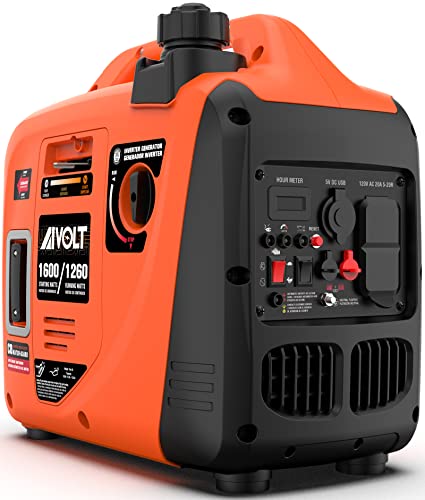
- Power Quality: THD below 3% ensures safe charging for phones, laptops, and small electronics.
- Runtime: About 8 hours at 25% load with a 60cc engine and eco-mode for fuel efficiency.
- Weight: Lightweight at ~28 lbs, making it highly portable for campers and tailgaters.
Best for: campers who prioritizes ultra-quiet operation and clean power for fragile electronics while keeping weight down. Better for solo trips or small groups with modest energy needs.
Limitation: While compact, the power ceiling is lower than larger open-frame models, so plan for essential devices only.
Aceup Energy 1200W Gas Generator

- Power: 1200 peak / 900 running watts with a 1.1-gallon tank supports basic appliances and devices.
- Outlets: Includes AC 120V and a 12V DC outlet for versatile charging options.
- Runtime: Up to 6 hours at half load on a full tank, balancing efficiency and practicality.
Best for: campers who want a compact, straightforward unit with essential outlets for core camping gear and small electronics. Choose this if you need simple operation and reliable, steady power.
Caution: For higher loads, this unit may require more frequent fueling or switching to a larger model.
PowerSmart 3800 Watt Dual Fuel Inverter Generator
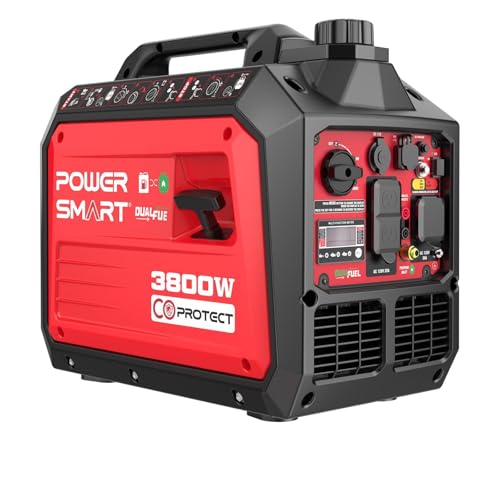
- Fuel options: Dual fuel (gasoline or propane) for longer-term flexibility on extended trips.
- Power: 3800 starting / 3300 running watts on gasoline; 3500 starting / 3100 running watts on propane, suitable for heavier load.
- Noise: Operates with a reasonable noise level for a larger inverter generator in camp settings.
Best for: campers who want versatile fuel choices plus substantial power for larger campsites, RVs, or emergency needs. Best for longer excursions where fuel availability and noise management matter.
Limitation: Heavier than single-fuel small units; not ideal for ultra-portable backpack-camping scenarios.
Buying Guide: Small Gas Generators For Camping
- Assess your real power needs: List essential devices (lights, fridge, CPAP, laptop) and total their running watts. Pick a generator with a comfortable margin above that total.
- Weight and portability: If you shuttle gear between locations or hike to a site, prioritize models under 35 pounds with integrated handles.
- Run time and fuel tank size: Longer trips benefit from larger tanks or higher fuel efficiency. Consider ECO or economy modes to stretch fuel.
- Noise considerations: Look for generators marketed as quiet or with low decibel ratings (approx. 57-60 dBA at a safe distance) to avoid disturbing others at campgrounds.
- Power quality: For sensitive electronics, prefer inverter generators with THD under 3% to protect devices like laptops and cameras.
- Fuel logistics: Gasoline is widely available but requires storage safety. Dual-fuel options offer flexibility when propane is more convenient or affordable.
- Outlets and compatibility: Ensure the unit provides the right outlets for your devices (AC 120V, USB, 12V DC). RV-ready ports are a plus for campers with trailers.
- Safety features: Look for low oil/shutoff indicators, automatic shutoff on low fuel, and CO protection sensors if included or recommended by the manufacturer.
FAQ
- What size generator is best for tent camping?
– A portable inverter generator in the 1000–2000W range is typically enough for basic lighting, charging, and small appliances, with quieter operation and good fuel economy. - Are inverter generators more suitable for camping than conventional ones?
– Yes. Inverter models provide cleaner power, are generally quieter, and offer better fuel efficiency for intermittent use common in camping scenarios.
- Can I parallel multiple generators for more power?
– Some models offer parallel capability, allowing two units to be linked for higher output, but check compatibility and safety guidelines in the user manual. - What maintenance should I perform before a camping trip?
– Check oil level, fuel stability, air filter condition, and spark plug health. Store fuel safely and run the unit briefly to ensure readiness. - Is dual-fuel a worthwhile option for camping?
– Dual-fuel generators offer flexibility when you have propane available or when gasoline is scarce. They add versatility for long trips. - How do I minimize noise at a campground?
– Run the unit at the lowest practical load, place it on a solid surface away from tents, and use a noise-reducing enclosure or mat if allowed by park rules.