When you’re camping in a trailer, staying connected matters. This guide focuses on practical, reliable WiFi solutions for RV parks, remote campsites, and off-grid locations. It highlights a mix of portable travel routers, cellular hotpots, solar-powered cameras for security, and outdoor extenders. The top picks are chosen for ease of use, durability, and how well they suit different traveler needs—solo travelers, families, and those who work remotely from the road.
Summary table of selected products:
| Product | Best For | Key Benefit |
|---|---|---|
| TP-Link Roam 6 AX1500 Travel Router | Hotel, RV, and on-the-go sharing | Fast Wi‑Fi 6 for multiple devices |
| TravlFi JourneyGo LTE RV WiFi Hotspot | RV travel with data plans | No contracts; versatile data options |
| WAVLINK AC600 Outdoor WiFi Extender | Campsites and outdoor spaces | Outdoor range extension and PoE option |
| Xega 4G Cellular Security Camera | Off-grid security | Cellular, no WiFi needed; long battery |
| MAXDONE Solar Trail Camera | Solar-powered wildlife monitoring | 4K/64MP with solar charging |
TP-Link Roam 6 AX1500 Travel Router

Best for: campers who need fast, shared Wi‑Fi while on the road. This router delivers Wi‑Fi 6 speeds (up to 1201 Mbps on 5 GHz and 300 Mbps on 2.4 GHz) to support streaming, video calls, and gaming for multiple devices. It can create a private network from public Wi‑Fi or act as a portable hotspot, making it ideal for RV sites with mixed network access. VPN capability adds a layer of secure remote work or private browsing. It is designed to work with Ethernet, USB tethering, or as an access point to extend wired connections wirelessly.
Why selected: It covers common camping scenarios—sharing a public hotspot, securing connections at campgrounds, and providing a stable Wi‑Fi backbone for multiple devices aboard a trailer. Its multi-mode flexibility reduces dependence on a single network source. A potential limitation is that speeds depend on the available public network or tethered connections, which can vary at remote sites.
TravlFi JourneyGo LTE RV WiFi Hotspot

Best for: RV travelers who want private internet without long-term contracts. JourneyGo offers coverage across the U.S. with no SIM required and flexible data plans, including options like prepaid data. It’s compact and designed for portability, making it suitable for folks who value simplicity and predictable data budgeting while on the road.
Why selected: It avoids reliance on public networks and provides a pocket-sized solution for reliable connectivity. The data plan choice makes it easier to manage internet use during long trips. Limitation: the device is dependent on cellular coverage and data plans, so performance can vary by location and carrier strength.
WAVLINK AC600 Outdoor WiFi Extender

Best for: campers needing to boost existing campground or home Wi‑Fi to outdoor areas around a trailer. This 3-in-1 device works as a repeater, router, or access point, and offers outdoor-grade durability with IP67 waterproofing. It can extend a network to portable devices and outdoor cooking spaces, making it a practical addition for seats, awnings, and exterior camp kitchens.
Why selected: It provides significant range improvement and multiple operating modes, enabling flexible deployment. A drawback is that actual outdoor performance depends on the strength of the base network and environmental interference.
Xega 4G Cellular Security Camera
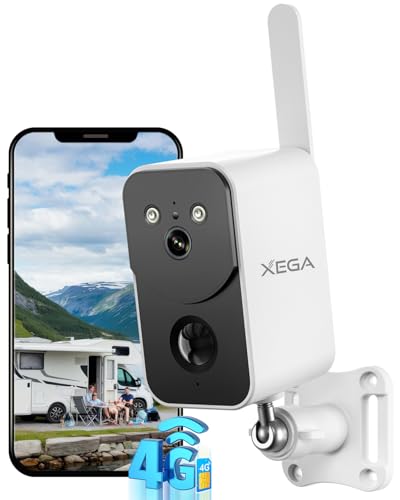
Best for: off-grid security without local Wi‑Fi. This 4G LTE camera operates independently of any Wi‑Fi network, featuring a built-in Nano SIM and a long-lasting 10000 mAh battery. It supports up to 20 m night vision and two-way audio, making it suitable for remote properties, camp entrances, or a trailer exterior.
Why selected: It provides perpetual surveillance where power or internet may be limited. The main caution: you must have a compatible data plan for the SIM and 4G coverage, and the camera relies on cellular signals rather than a home or campground Wi‑Fi network.
Sixeye 4G LTE Cellular Trail Camera (2 Pack)

Best for: wide-area wildlife monitoring when Wi‑Fi is unavailable. This two-pack cellular trail camera uses built-in 4G LTE and does not require Wi‑Fi. It offers 355° panoramic PTZ coverage and fast motion sensing, with color night vision and two‑way audio. It’s suitable for remote campsites, hunting cabins, or large outdoor properties.
Why selected: It enables remote observation with minimal maintenance and no reliance on local networks. Limitation: performance depends on cellular signal strength, and costs may accumulate with data usage on the SIM plan.
Trail Cameras With WiFi And Solar Options

Best for: campers seeking solar-powered camera solutions with WiFi control. This selection covers models that allow local smartphone control and quick photo/video transfer via apps like Trailcam Go. They’re ideal for campers who want wildlife monitoring with reduced maintenance when off-grid.
Why selected: Solar charging and remote monitoring reduce the need for frequent battery changes. A potential limitation is the need for a compatible app ecosystem and possible range constraints for WiFi control to connect to the camera.
Buying Guide
What should be considered when choosing WiFi gear for a camping trailer:
- Connectivity type: Do you need a travel router that shares public Wi‑Fi, a cellular hotspot, or a completely offline security camera system?
- Power availability: Is solar charging or a portable power source a priority? Consider devices with battery back‑ups or PoE if available.
- Coverage needs: How many devices will connect at once, and will you be in a large campsite or a remote site?
- Portability and durability: Look for compact, rugged designs suitable for outdoor use and rough conditions.
- Data plans and costs: Cellular options require data plans; assess your typical camping duration and data needs.
- Security: VPN capability, private networks, and encrypted connections add protection when using public networks.
- Ease of setup: For busy travelers, a plug‑and‑play solution with clear app controls saves time.
FAQ
- What’s the simplest way to get WiFi in a camping trailer?
- Do I need a cellular hotspot for RV travel?
- Can I use solar power to run WiFi devices?
- Is outdoor WiFi extenders worth it for camping?
- What should I consider for security on the road?
- Will these devices work everywhere?
The simplest approach is a portable travel router that can share a public campground Wi‑Fi and create a private network for your devices.
If you’re often in areas with weak campground Wi‑Fi or no public networks, a cellular hotspot with a data plan offers consistent connectivity.
Yes. Many outdoor cameras and some routers support solar charging or battery backups, making them suitable for off-grid use.
Outdoor extenders help extend existing networks to campsites or awnings, but require a reliable base network to maximize performance.
Choose devices with private networks, VPN compatibility, and secure app controls to protect data while traveling:
Cellular devices depend on network coverage. Satellite options exist, but are more specialized and costly.