Kids love adventures, and the right outdoor survival kit can turn every hike, campground, or backyard expedition into a learning experience. This guide highlights five kid-friendly survival kits designed to develop exploration, problem-solving, and teamwork while keeping safety in mind. Each option appeals to different ages and activity levels—from beginner explorers to teens seeking more comprehensive gear. The table below compares key aspects to help you choose quickly.
| Product | Best For | Key Benefit | Note |
|---|---|---|---|
| CEREM Kids Explorer Kit | Young children and beginners | All-in-one bundle with walkie-talkies, binoculars, compass | Screen-free play encouraged |
| Outdoor Survival Kit 7 in 1 (Top Lander) | Teenagers and families | Compact, multi-tool set for multiple tasks | Lightweight and portable |
| Kidz@Play Adventure Kidz Kit | Young adventurers | Educational set with magnifying glass, whistle, torch | Backpack included |
| kaqinu 24 Pcs Explorer Kit | Family outings and classroom demos | Wide accessory variety including bug catcher | 4x magnification for bugs |
| ZLemma Kids Pocket Knife & Survival Kit | Older kids ready for basic cutting tools | Safe locking knife with safety features | Includes multiple essentials |
CEREM Kids Explorer Kit – 10-in-1 Nature Explore Set

The CEREM Kids Explorer Kit is designed for younger explorers who need an all-in-one solution. With walkie talkies, binoculars, a compass, LED flashlight, collapsible water bottle, and a compact backpack, this bundle minimizes setup time and maximizes immediate outdoor use. The kit emphasizes screen-free play to boost observation skills and curiosity in outdoor settings. Best for beginners who want a complete, ready-to-go kit that supports basic navigation and discovery activities.
Who it’s best for: parents seeking a single, simple kit to engage elementary-age children in outdoor exploration without adding separate pieces. Why selected: it packages essential exploration tools in one box and uses age-appropriate gear that encourages real-world learning.
Caution: ensure children understand flashlight and walkie-talkie safety rules to avoid misuse during sensitive wildlife observations.
Outdoor Survival Kit 7 in 1 (Top Lander)

This compact kit covers multiple survival basics in a slim case, making it a solid pick for teens or family outings where space matters. It includes a stainless steel tool card, fire starter, compass, wire saw, emergency whistle, multifunctional pliers, and a carabiner. The lightweight design (about 8.1 ounces) makes it easy to carry in a glove box, daypack, or camping bag. Choose this if you want a single pocket-sized set that still offers diverse survival functions.
Who it’s best for: older kids or teens who can handle sharpening fire-starting skills and basic tool use. Why selected: high versatility in a minimal footprint, suitable for demonstrations and backcountry practice alike.
Caution: the kit’s durability depends on proper maintenance; keep tools dry and inspect edges after heavy use to ensure safe operation.
Kids Pocket Knife With Camping Survival Kit (ZLemma)

The ZLemma kit centers on safety-first practice for budding explorers. It features a dedicated kids pocket knife with a locking mechanism, a waterproof pouch, and two carabiners for easy attachment. The kit also includes a multifunction card tool, a fire starter with striker, a whistle, and a compass keychain. Best for curious children who are ready to handle a basic cutting tool under supervision. The included safety lock makes it a practical entry point for practical camping skills.
Who it’s best for: families introducing safe knife handling and essential survival tasks to older children. Why selected: emphasis on safety with a locking knife and a complete coordination of tools in one compact package.
Caution: supervision is required when using the knife, and ensure your child understands proper blade etiquette and storage when not in use.
Adventure Kidz Outdoor Exploration Kit (Kidz@Play)

The Adventure Kidz kit from Kidz@Play blends educational elements with fun, featuring kid-friendly binoculars, a torch with manual recharging, a compass, whistle, magnifying glass, and a practical backpack. The set is designed to support STEM learning through exploration and pretend play. Best for instructional play in casual camping or nature walks where discovery and observation high points matter. The included backpack helps kids organize tools for on-the-go adventures.
Who it’s best for: younger explorers and families who value hands-on scientific curiosity. Why selected: strong emphasis on learning through discovery, with multiple tools that promote observation and critical thinking.
Caution: check that the lantern’s manual crank operation remains smooth and safe; teach proper cranking technique to avoid discomfort during use.
kaqinu 24 Pcs Explorer Kit
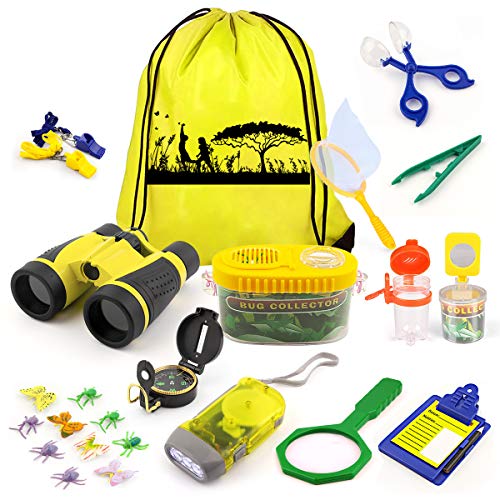
This 24-piece explorer kit expands on the basics with a wide array of accessories, including binoculars, a lensatic compass, a bug catching set, magnifying glass, butterfly net, and a note pad. It supports deeper nature study, insect observation, and hands-on exploration. Best for families that want a broader toolkit for outdoor classrooms or extended camping trips. The 4x magnification and bug-catching components encourage curiosity in biology and ecology.
Who it’s best for: kids who enjoy in-depth nature exploration and guided discovery activities. Why selected: the breadth of tools enables richer outdoor lessons and longer play sessions.
Caution: the assortment may be more challenging to manage for very young children; supervision helps maintain safety and organization.
Buying Guide: Practical Considerations For Choosing A Kids’ Survival Kit
- Age and safety: Match the complexity of tools to your child’s age and ability. Look for locking blades, bright colors, and size-appropriate handles. Supervision is essential for any knife-based gear.
- Portability vs. completeness: A compact set is easy to carry, but ensure it includes essential items like a flashlight, compass, whistle, and a bag or case for organization. For older kids, broader kits can provide more learning opportunities.
- Educational value: Kits that include a compass, magnifying glass, or bug-catching components encourage observation, navigation, and scientific curiosity. Consider kits that support STEM activities and practical outdoor skills.
- Durability and materials: Look for sturdy construction and water-resistant pouches or cases. Stainless steel tools and robust plastics resist wear in outdoor environments.
- Safety and supervision: Set rules around tool use, safe handling of blades, and responsible camping practices. Use protective gear where appropriate and ensure kids know how to signal for help.
- Storage and organization: A clear, labeled kit helps kids learn accountability and responsibility. Quick-access pockets and labeled compartments support easy retrieval during activities.
- Longevity and expansion: Consider whether you want a single starter kit or a modular setup that can be expanded with additional accessories over time to align with growing skills.
Frequently Asked Questions
- What age is appropriate for a kids’ survival kit? Answer: It depends on the tools included; start with kits designed for younger children (with safe features) and progress to more advanced sets as skills develop under supervision.
- Should a survival kit include a knife for kids? Answer: Only if the knife has a locking mechanism, is clearly labeled for kids, and is used under strict supervision and safety training.
- What’s the best kit for learning navigation? Answer: Kits that include a simple, kid-friendly compass and a basic map activity are ideal for teaching directions and geography in a hands-on way.
- How do I store these kits to keep them ready for use? Answer: Use a labeled, resealable backpack or case with compartments, and check items regularly for wear or damage.
- Can these kits be used indoors? Answer: Yes. Many items—like binoculars, magnifying glasses, compasses, and notebooks—are suitable for indoor science exploration and pretend play.
- How do I choose between a large 24-piece kit and a smaller 7-in-1 kit? Answer: Choose based on the child’s age, interest level, and the activities you plan; larger kits offer more exploration options, while compact kits are easier to manage.