Finding the right camping trailer water pump means balancing flow, pressure, power source, and reliability. This guide highlights five solid choices for different RV, camper, and off-grid needs. Each product is evaluated for who it’s best for, why it’s selected, and any limitations to consider. Ideal buyers include full-time RVers seeking steady pressure, weekend campers needing quick setup, and off-grid users prioritizing low power draw or dry-run protection.
| Product | Best For | Key Benefit | Notes |
|---|---|---|---|
| ECO-WORTHY RV Fresh Water Pump | Casual to moderate use in RVs | 9.8 ft prime lift, adjustable 35–80 PSI | Thermal protection; auto shut-off |
| WASSERMANN RV Pump | All-purpose RV and marine setups | 4 GPM, 45 PSI with kit | Complete kit; 12V DC powered |
| SEAFLO 33 Series | RVs and boats needing NSF/UL compliance | 3.3 GPM at 45 PSI; strong warranty | NSF/ANSI/UL standards |
| MRGVFLO Upgraded 7GPM | Off-grid or larger water systems | 7 GPM, 70 PSI | Five-chamber, quiet operation |
| Bootee 4.0 GPM | Versatile multi-use campsites | 101 ft lift, 9.8 ft suction | Automatic 45 PSI switch |
ECO-WORTHY RV Fresh Water Pump 12V DC 3.5GPM

The ECO-WORTHY pump delivers 3.5 GPM at 45 PSI and self-primes up to 9.8 vertical feet. It features an adjustable pressure range of 35–80 PSI and a thermal overload protection to guard the motor. This unit is best for light to moderate RV use where a compact, self-priming pump is preferred. A potential limitation is if you demand very high flow rates or if you frequently operate at the upper end of the pressure range.
WASSERMANN RV Pump, 12V Self-priming 4.0GPM 45PSI

This kit-style pump provides up to 4 GPM at 45 PSI and includes hoses, adapters, a debris filter, and manual. It is well-suited for RVs or campers needing a ready-to-run package with dependable 12V DC power. Choose this if you want a broader installation kit and straightforward replacement parts. A caveat is that the kit’s comprehensive nature may add complexity to installation for single-appliance setups.
SEAFLO 33 Series 110V/115V Fresh Water Pump

The SEAFLO 33 Series is a 115V diaphragm pump rated at 3.3 GPM and 45 PSI with a smart pressure switch. It is NSF/UL compliant and backed by a four-year warranty, making it a strong pick for campers and small boats that have 110–120V power. It’s best for stationary or shore-power use; if you need a 12V option, this model is less suitable. Potential limitation: higher energy use compared with 12V pumps.
[Upgraded Version] MRGVFLO 7GPM 70PSI
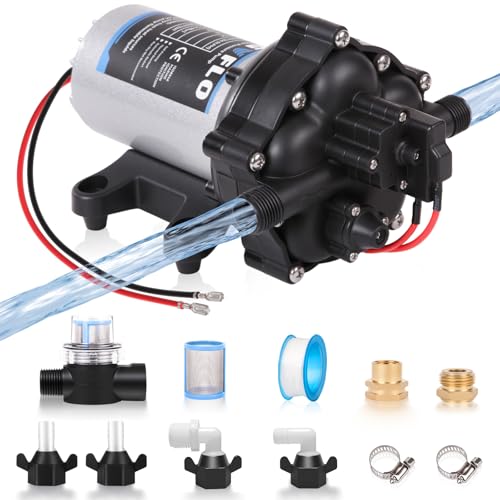
The MRGVFLO pump offers 7 GPM at up to 70 PSI with a five-chamber diaphragm design and NSK bearings, resulting in higher flow with relatively quiet operation. It’s ideal for larger water systems on RVs or off-grid setups that require robust performance. Use this when you need stronger shower and sink supply. Caution: system wiring must support higher current, and the installation supports longer run lengths should be verified.
Bootee 12V RV Water Pump 4.0 GPM 45PSI

The Bootee pump delivers 4.0 GPM at 45 PSI with a 101-foot lift and 9.8-foot suction, plus an automatic pressure switch for demand-driven operation. It suits multi-use settings, including RVs, marine, and light garden tasks. Best for users who need solid performance across showers, sinks, and small outdoor cleaning. Limitation: ensure the power system can handle the 45 PSI motor demands during peak flow.
DICMIC 3.0 GPM 12V 55 PSI Revolution Pump

The DICMIC Revolution pump provides 3.0 GPM at 55 PSI with a one-piece diaphragm and built-in check valve. It aims for long life and stable pressure with dry-run resistance. Best for RVs where compact size and durable diaphragms matter. Consider compatibility with your existing fittings and whether lower flow is acceptable for your fixtures.
Buying Guide
Power source: Choose 12V DC for vehicles and off-grid use, or 110–120V AC for shore-power setups. Battery capacity and wiring should match the pump’s current draw, especially for higher-flow models.
Flow vs. pressure: Higher GPM helps with showers and multi-faucet use; higher PSI improves fixture performance in long runs. Balance both for your RV layout.
Self-priming and dry-run protection: Self-priming features simplify installation. Look for dry-run protection or thermal cutoffs to protect the motor during bursts when water is scarce.
Material compatibility: Ensure the pump accommodates potable water if used for drinking water. Certifications (NSF/UL) indicate compliance with safety standards.
Accessories and installation: Some pumps come as complete kits with hoses and adapters; others require separate purchases. Factor in your existing plumbing fittings and the space available in the utility area.
Noise and vibration: Five-chamber designs and NSK bearings reduce noise, which improves comfort on longer trips. Consider mounting options to minimize vibration transfer in the RV cabinet.
Maintenance: Check for easy access to diaphragms and filters for routine maintenance. Replacement diaphragms and seals should be readily available.
FAQ
- What is the typical GPM need for a basic RV shower?
Most RVs operate well with 3–4 GPM for showers and sinks combined at moderate pressure. - Is a 12V pump enough for all RV needs?
Yes for many trailers, but high-demand setups may benefit from higher GPM or additional pumps for simultaneous fixtures. - Do NSF or UL certifications matter?
NSF/UL standards ensure safe materials for potable water and electrical safety in outdoor environments. - Should I choose a 110V pump or a 12V pump?
12V is ideal for off-grid use; 110V is convenient near shore power but requires a stable electrical supply. - What is dry-run protection and why is it important?
Dry-run protection stops the motor if water runs dry, preventing damage and extending pump life. - Can I install any pump in my RV?
Installation compatibility depends on fittings, wiring, and space. Consult the product’s manual for specifics.