Answer: Rooftop tents offer elevated sleeping, quick setup, and all-season comfort for travelers who want versatility, privacy, and off-grid capability. This guide highlights five top picks suitable for different buyers—families, solo explorers, and weekend campers. Each section explains who it’s best for, why it was selected, and important considerations like insulation, weight, and durability. A quick comparison table helps you scan features at a glance.
| Product | Best For | Why It Stands Out | Limitations |
|---|---|---|---|
| Adventurer Pro Rooftop Tent (HEYFUN) | Family groups or three-person setups | Aluminum hard shell, side awning, built-in LED strip | Heavier; vehicle clearance matters |
| WildFinder Rooftop Tent (Gray) | All-season city and nature trips | Durable aluminum, moisture and condensation features | Limited color options |
| Naturnest Sirius 1 Plus | Four-season off-road adventures | All-weather fortress, 82.7 x 63-inch interior | Higher price tier |
| Sanhima Jervis Overland | Stargazing and light-weight travelers | Lightweight ABS shell, stargazer window | Limited insulation details |
| ARCTWONDER Rooftop Tent | Tech-enabled travelers | Solar panel, wind and rain protection | Educational spec mix; verify power needs |
Adventurer Pro Rooftop Tent With Side Awning

The Adventurer Pro from HEYFUN uses a robust aluminum hard shell and includes an attachable side awning plus a built-in LED light strip. It is designed for 2-3 people, with closed and opened dimensions offering substantial interior space and a strong load capacity. Best for families or camping with a small group where privacy and shelter from the elements matter. The setup emphasizes durability and all-season use, making it a solid choice for longer trips in varied weather. A noted limitation is its heavier weight, which may affect fuel consumption and require a higher-capacity roof rack.
WildFinder Rooftop Tent Hard Shell for Jeep, SUV, Truck

This tent emphasizes a durable 100% aluminum alloy build with a stainless steel air pressure lever and a moisture-resistant fabric system. It includes a recessed marine pad and a 5 cm mattress for comfort and reduced humidity. Best for travelers who want a rugged, long-lasting shelter with strong weatherproofing and privacy features. It is better for those prioritizing corrosion resistance and a breathable interior. A limitation to note: while it offers strong build quality, the lack of explicit insulation details means winter use should be evaluated with additional liners or heating solutions.
JOYINRUTE Aluminum Rooftop Tent With Winter Insulation

The Joyinrute tent uses high-quality aluminum alloy with a quick-opening mechanism via hydraulic rods. It includes a disassemblable winter thermal liner for cold-weather insulation, turning a rooftop tent into a true all-season shelter. It’s best for campers who want reliable warmth and easy setup, especially in cooler climates. Choose this if you prioritize fast deployment and winter readiness. A potential limitation is the need to manage the liner when temperatures rise, as it adds layers to the setup process during warm seasons.
ARCTWONDER Rooftop Tent With Solar Panel

This hard shell tent is built with durable aluminum at key points and includes a 12V216W solar panel for charging power banks and devices. The tent opens and closes easily with air pressure rods, and its low closing height reduces roof-line interference. Best for tech-minded campers who want on-the-go power and straightforward operation. Avoid this if you require higher insulation for extreme cold without additional gear or if your vehicle’s roof height is already near clearance limits.
WildFinder Hard Shell Rooftop Tent for 2-3 People

Another WildFinder option focuses on a 2-3 person setup with the same aluminum alloy construction and moisture-control layers as the earlier model. It provides blackout fabric and privacy, along with an ergonomic air-pressure system for quick deployment. Best for mixed-weather trips where privacy and quick setup are priorities. A caution: verify the load limits and ladder stability for taller vehicles or heavier camping gear.
San Hima Jervis Overland Rooftop Tent
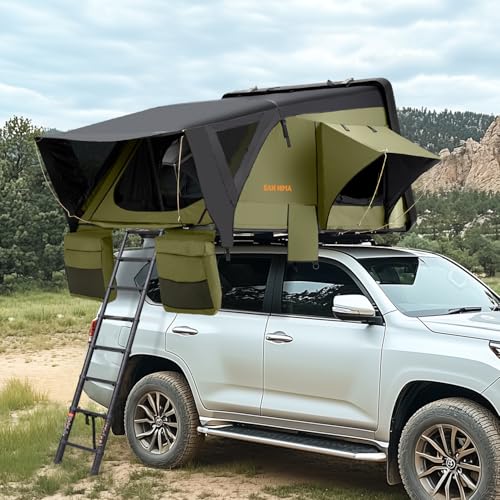
The Jervis overland model emphasizes a starry stargazer window and a spacious interior with a 90+ inch ladder reach, designed for comfort and a broad night-sky view. It uses an ABS shell for wind drag reduction and weather resistance. Best for couples or small groups who prize a wide sleeping area and celestial viewing. A caveat is that the insulation is not detailed in the listed features, so rely on supplemental sleeping gear for extreme temperatures.
Buying Guide
What should I look for when choosing a rooftop tent?
- Material and durability: Aluminum hard shells resist weathering and provide long-lasting performance; compare shell thickness and frame construction.
- Insulation and weatherproofing: All-season use benefits from insulation layers and moisture protection; check if a thermal liner is included or available.
- Ventilation and condensation: Look for breathable fabrics, condensation mats, and mesh windows to reduce humidity inside the tent.
- Weight, fit, and mounting: Ensure your roof rack and vehicle can support the tent weight; verify dimensions when closed and opened.
- Power and amenities: Solar panels and built-in lighting add convenience for off-grid trips; confirm amperage and outlet options.
- Setup ease: Hydraulics or gas struts speed opening and closing; practice in a safe, level area before trips.
- Space and comfort: Interior dimensions and mattress thickness influence sleeping comfort for two or three occupants.
- Weather protection: Look for water resistance ratings, seal design, and canopy options to shield from rain and wind.
Practical buying questions
- Which tent is best for families? The Adventurer Pro offers 2-3 person space with an awning, making it suitable for families or small groups seeking sheltered outdoor seating.
- Do I need solar power on a rooftop tent? If you camp off-grid often, a model with a solar panel (like ARCTWONDER) helps keep devices charged without relying on campsite power.
- Is insulation necessary in all climates? Yes for winter or high-altitude trips; in mild climates, a winter liner may be optional.
- What about installation and roof load? Check your vehicle’s roof load limit and rack compatibility; some models are heavier and require reinforced racks.
- Should I prioritize insulation or lightweight design? For year-round use, insulation is important; for summer-only trips, a lighter shell with good ventilation can be sufficient.
- Are all these tents universal for many vehicles? Most fit a range of SUVs, trucks, Jeeps, and vans, but it’s essential to confirm mounting hardware compatibility with your specific vehicle.
Frequently Asked Questions
- Q: Can rooftop tents be used on trucks and SUVs alike? A: Yes, most are designed for trucks, SUVs, and SUVs with compatible rails or crossbars; verify the mounting system for your vehicle.
- Q: Do rooftop tents require special installation tools? A: Basic tools and the provided hardware usually suffice; some models rely on hydraulic supports for quick setup.
- Q: How do I maintain moisture control inside the tent? A: Use the condensation pad, ventilated windows, and keep the interior dry; consider a breathable ground mat and dehumidifying sachets.
- Q: Are solar panels essential for camping? A: Not essential, but highly convenient for extended trips without access to grid power.
- Q: What is a good all-season rooftop tent choice? A: Tents with insulated liners or winter-ready configurations, such as those offering thermal layers, are better for all-season use.
- Q: Can rooftop tents be used on flat-ground sites? A: Yes, but check stability and ensure the ladder and anchor points are secure on uneven terrain.