If you need cooling in a tent, choose a portable, low-setup unit designed for outdoor use and tighter spaces. The top options here are compact, USB-friendly, and provide multiple modes to match different camping or outdoor scenarios. This guide highlights five tents-friendly portable ACs, tailored for solo campers, families in tents, RV travelers, and anyone seeking quick cooling without heavy installation. Each product includes its best-use case, a clear limitation, and why it stands out in a camping setup. A quick comparison table follows to help you decide faster.
| Product | Best For | Key Benefit | Limitation |
|---|---|---|---|
| WUEZOE Portable Air Conditioner | Solo travelers and small tents | 4-in-1 functionality with mist and night light | Water tank needs monitoring |
| Evapolar evaCHILL | Personal cooling in hot climates | Low power use (10W) and portable design | Designed for personal cooling, not room-wide |
| Karinear Portable AC for Camping | Outdoor tents and patio spaces | Three cooling modes with remote control | Requires standard 110V outlet |
| BougeRV PC35 Portable AC | App-controlled camping setup | App control for easy adjustments | Limited to small spaces |
| FO-KOKO Dual Hose 6800 BTU | Rapid cooling in small tents | Dual-hose design for faster cooling | Heavier than single-hose units |
WUEZOE Portable Air Conditioner: 4-in-1 Personal Cooler
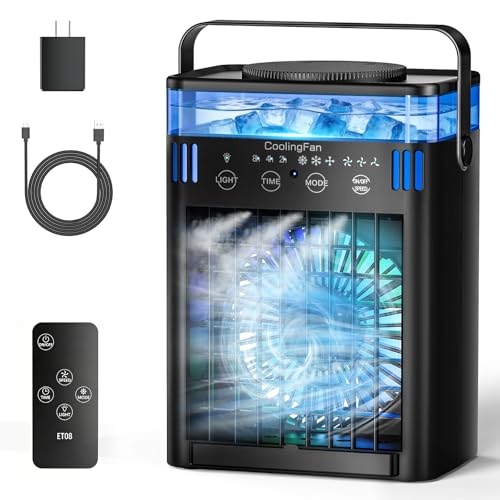
The WUEZOE model blends cooling, humidifying, a fan, and a night light into one compact unit. Best for solo campers who want a lightweight, plug-and-play solution in a small tent or dorm-like setup. It provides three mist levels and three fan speeds, enabling a quick and customizable breeze. The 1000ml water tank supports long runtimes, reducing the need for frequent refills. A cautions note: if the water is low, the unit safely switches to natural fan mode to avoid misting. Ideal for dry climates or casual camping where a mist feature adds comfort.
Who it’s best for: A solo camper or student in a small space who wants flexible modes without complex setup. Why selected: excellent 4-in-1 value in a portable footprint, plus a sizable tank for uninterrupted use. Caution: monitor water level to maintain mist output and prevent dry-air operation.
Evapolar evaCHILL Personal Evaporative Cooler

The evaCHILL is designed for personal cooling in hot environments, such as a tent or car desk setup. It uses evaporative technology to humidify and cool the immediate area, with a lightweight handle for portability. With four fan speeds and a simple one-button control, it performs best at close range (roughly 3–5 feet). It’s energy-efficient (about 10W) and can be used alongside another AC unit to reduce energy use while preventing air dryness. Limitation: not suitable for cooling an entire tent or room-sized space.
Who it’s best for: Anyone seeking a low-energy personal cooling device for hot, dry climates or a quick breeze within a small personal area. Why selected: minimal power draw and straightforward operation. Caution: most effective when used within a limited radius and higher humidity is a consideration for evaporative cooling.
Karinear Portable Camping AC for Camping and RVs

The Karinear unit delivers 3300 BTU cooling with three modes: Cool, Dehumidify, and Fan. It’s compact enough for tents and small rooms up to around 30–62 square feet, cooling down to about 60°F quickly. A remote control adds convenience for adjusting temperature and modes from a distance, making it suitable for a seated camper. The 0–24 hour timer lets you pre-set operation times, preserving battery or power when off-grid. Best for quick, targeted cooling in outdoor setups where outlets are available. Limitation: requires an electrical outlet to maximize performance.
Who it’s best for: Campers or RV users who want remote control and a simple three-mode system. Why selected: strong balance of portability, control, and speed in a compact form. Caution: keep expectations reasonable for larger tents or high-heat days without a power source.
BougeRV PC35: App-Controlled Tent Cooling
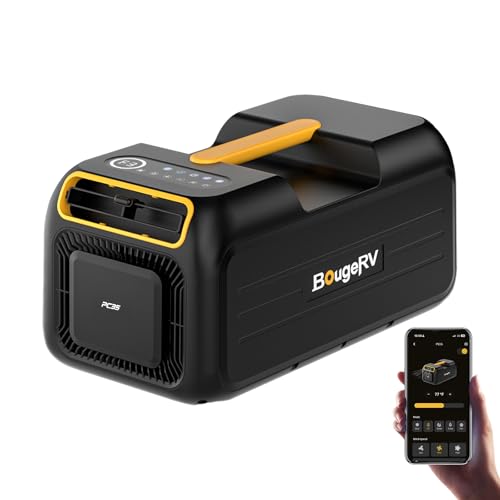
The BougeRV PC35 brings app control to a compact 3500 BTU unit, designed to handle small tent spaces or compact indoor environments. It supports temperature adjustments, three modes, and an adjustable timer via the BougeRV app within about 33 feet. This makes it a practical choice for campers who want to fine-tune climate conditions without leaving their seat. Selection rationale: integrates modern control with portable cooling for ease of use. Limitation: app reliability and connectivity can influence experience in remote locations.
Who it’s best for: Tech-minded campers who prefer remote access and easy adjustments from a distance. Why selected: modern convenience in a tent-friendly size. Caution: ensure your smartphone remains within range for uninterrupted control.
FO-KOKO Dual Hose 6800 BTU: Fast Cooling and Heating

The FO-KOKO unit uses a dual-hose design and offers 6800 BTU cooling with 7500 BTU heating, plus five modes (Cool/Heat/Dry/Fan/Sleep). It’s designed to cool tents, RVs, vans, and similar spaces quickly, with a windowless design and a weight around 34 pounds. The dual-hose setup improves heat exhaust and overall efficiency, making it a strong choice when you need faster temperature drops. Limitation: heavier to transport and requires more setup space than ultra-light models.
Who it’s best for: Campers who need quicker cooling and year-round comfort, including in slightly cooler or shaded tents. Why selected: robust performance and broader climate control. Caution: heavier unit may be less convenient for hikers or irregularly spaced campsites.
Outohome 5200 BTU: Practical Tent Cooling

The Outohome 5200 BTU portable tent AC offers strong cooling for camping and smaller indoor spaces. It features four modes: Cooling, Dehumidifying, Sleep, and Fan, with a 24-hour timer for automatic shutoff. It has a compact footprint and a weight around 31 pounds, making it easier to move than larger models. Limitations include performance variance in high heat or large tents and the need for power access for optimal operation. Best for: campers seeking reliable cooling with flexible modes and a timer for overnight use.
Buying Guide: Key Considerations For Tent Cooling
What size tent will you cool? Measure your space and compare it to the unit’s BTU rating. Smaller tents benefit from 3,000–5,000 BTU units, while larger tents may need 5,000–8,000 BTU or more, especially in direct sun.
Do you need heater capability? Some models offer heating in addition to cooling. If you camp in shoulder seasons, a 5-in-1 unit could deliver year-round comfort.
Power source and energy use matter. Battery-only units are rare at higher capacities; look for models that work with standard portable power stations or outlets. Evaporative coolers use less energy but require dry air for effective cooling.
Noise level affects sleep and conversation. Look for units with noise below 50 dB in sleeping modes for quiet nights.
Portability and setup. Consider handle design, weight, and whether you’ll need a remote control or app. Dual-hose models tend to cool faster but are heavier and more complex to set up.
Water or moisture considerations. Some units rely on water tanks or ice to boost cooling. If you camp in humid environments, evaporative cooling may be less effective, and you may prefer sealed, mist-free options.
FAQ
Q: Will these portable units cool a large tent? A: Most are designed for small spaces or targeted areas. For larger tents, choose higher BTU models or pair with additional portable fans.
Q: Do I need shore power to use these? A: Many models work best with a standard outlet or power station. Some can operate on battery power, but capacity is often limited for cooling effectiveness.
Q: Are there energy-saving tips for camping with these units? A: Run in dehumidify or sleep mode when possible, use ice or cold water in the tank to boost cooling, and position the unit away from direct sun exposure to maintain efficiency.
Q: How important is the water tank size? A: A larger tank reduces refills during extended use, which is helpful in isolated campsites. Check the tank capacity and runtime in your model’s specs.
Q: Which model is best for a tent with a small doorway? A: Personal or 3-in-1 units with compact footprints and remote accessibility are ideal for tight entryways and easy placement.