Yes, the best sleeping bag cinch sacks are lightweight, water-resistant compression sacks that shrink bulky gear into compact volumes. They’re ideal for backpackers, campers, and travelers who need organized, space-saving solutions. Below are five top picks that balance lightweight design, durability, and practical features, with clear guidance on who each product suits best.
| Product | Best For | Key Benefit |
|---|---|---|
| Frelaxy 11L/18L/30L/45L Compression Sack | Backpackers needing variable sizes | 40% more storage, multiple sizes |
| Frelaxy Ultralight Turquoise Compression Sack | Minimalist travelers | Very light, reinforced seams |
| Frelaxy Ultralight Orange Compression Sack | Hikers who value packability | Double reinforced seam, lightweight |
| Quinnsus 2-Pack Stuff Sack | Organized gear for multi-item trips | Waterproof, rugged 210T ripstop |
| Borogo Compression Sack (24L/36L/46L) | Large gear storage needs | Multiple sizes, strong compression |
Each product section below highlights who it’s best for, why it was selected, and a practical caveat to consider before purchase.
Frelaxy 11L/18L/30L/45L Compression Sack

Best for campers who need a range of sizes in one line. This sack line promises up to 40% more space, balancing lightweight design with durability. Sizes cover S to XXL, with weights from 80g to 160g depending on size.
- Best for: Backpackers who must optimize packing density across different trips.
- Why selected: 4 adjustable straps yield even compression; bottom pull handle aids carry.
Caution: Heavier or bulkier models may be overkill for ultralight hikers who only need one compact size.
Frelaxy Ultralight Compression Sack Turquoise

Best for ultralight travelers who want minimal weight with solid durability. Features 210T tear-resistant polyester and a lightweight range around 70g–140g depending on size. Slippery interior aids easy packing.
- Best for: Day hikers and fast-and-light travelers.
- Why selected: Built to last with reinforced seams and four compression straps.
Caution: Interior slickness can make it slightly tricky to stuff very bulky items into the smallest size.
Frelaxy Ultralight Orange Compression Sack M

Best for travelers who prioritize compact packing. Lightweight design (sizes from S to XXL) with a double-reinforced seam for durability and a bottom carry handle.
- Best for: Pack-efficient campers needing lighter, compact sacks.
- Why selected: Similar capacity options plus reinforced seams for longer life.
Caution: Size selection is important to maximize space savings; the smallest size may not fit larger sleeping bags.
Quinnsus 2-Pack Stuff Sack
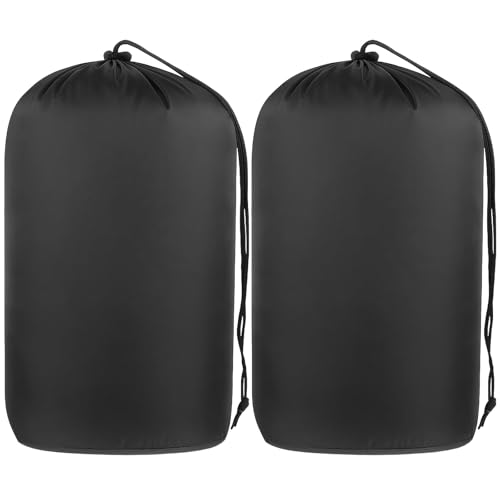
Best for gear organization on multi-item trips. Includes two 5.1 x 9.8 inch sacks, crafted from high-density ripstop 210T nylon with fully waterproof construction.
- Best for: Campers who need reliable organization for garments, toiletries, or electronics.
- Why selected: Waterproof design and rugged build for repeated use.
Caution: Not all cavities will fit very large sleeping bags; check dimensions before buying for your specific gear.
Borogo Compression Sack 24L/36L/46L

Best for travelers needing varied capacity and strong compression. This set covers 24L, 36L, and 46L sizes with four compression straps to maximize space or minimize footprint as needed.
- Best for: Long trips with varying gear quantities or when transporting bulky items.
- Why selected: Multiple sizes offer flexibility for packing different sleeping bags or clothing loads.
Caution: Some users may prefer waterproof zippers with bags of higher waterproof rating in heavy rain scenarios.
Buying Guide
How to choose a sleeping bag cinch sack: Start with capacity needs. If you carry multiple bags or bulky clothing, choose a pack with several size options (like the 11L–45L line). Consider weight and material: 210T tear-resistant polyester or nylon blends balance durability with lightness. Look for reinforced seams and multiple compression straps to maintain shape over time. A bottom carry handle adds portability, while a slippery interior helps with packing.
Material and durability: Polyester and nylon fabrics are common. Water resistance helps protect contents, but do not rely on sacks as the sole rain defense. For ultralight trekking, aim for sacks under 100g in the smallest size. For car camping or family trips, larger capacities provide better organization.
Fit and compatibility: Check sleeping bag dimensions and your other gear. If your bag is unusually large, a 46L or 45L option provides more accurate compression. If you want quick access, avoid overly tight sacks that require forcing items in.
Maintenance and care: Clean the exterior to remove dirt and lint. Dry thoroughly to maintain fabric integrity. Store uncompressed in a cool, dry place to prevent mold and mildew.
FAQ
- What is a compression sack used for? It reduces the volume of sleeping bags and gear, helping you fit more into a backpack.
- Are these sacks waterproof? Many are water-resistant with protective coatings, but not all are fully waterproof. Check product specs.
- How many liters should I choose? Choose based on the volume of your sleeping bag and additional gear. If in doubt, start with a mid-range 30L–45L option.
- Do they have handles? Several models include a bottom carry handle for easy transport.
- Will compression degrade fabrics? Reinforced seams and quality materials reduce wear; avoid over-compressing for long periods.
- Can I use these for clothes or electronics? Yes, many sacks are versatile for dry storage and organization beyond sleeping bags.