Answering the common search for RV owners, this guide highlights practical solar panel systems that fit different travel styles and budgets. The top picks here are best for off-grid travelers, weekend campers, and full-time RVers who want reliable, easy-to-install power without constant generator use. The list includes complete kits with panels, inverters, controllers, and batteries, plus clear notes on who each product is best for and any notable limits. A quick buying table follows to compare core specs at a glance.
Quick comparison at a glance
- Best all-in-one off-grid kit: ECO-WORTHY 7.168KWH 800W System (RV, long trips, heavy loads)
- Best starter kit: ECO-WORTHY 200W 12V Complete Solar Panel Starter Kit (RV beginners)
- Best mid-range 200W kit: ECO-WORTHY 200 Watts 12V Kit (RV, compact footprint)
- Best for compact RV setup: Renogy 200W Adventurer Kit (small footprint, easy install)
- Best high-output Renogy bundle: Renogy 400W Kit (higher daily energy, versatile)
ECO-WORTHY 7.168KWH 800W Complete RV Solar System

This all-in-one system targets RV travelers seeking powerful off-grid energy with simple setup. It combines four 200W bifacial panels, a 3000W inverter charger, two 12.8V 280Ah lithium batteries, and a Bluetooth MPPT controller. Best for full-time or long trips where high energy use is common. It supports 4-step installation and claims 3.2 kWh daily under optimal sun. Caution: the total weight and space requirement are significant for smaller RVs.
ECO-WORTHY 200 Watt 12V Complete Solar Starter Kit
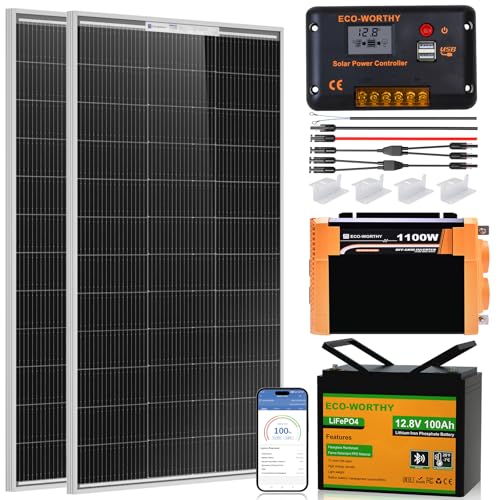
This starter kit is designed for RV newcomers who want a ready-to-use, all-in-one setup. It includes two 100W panels, a 12.8V 100Ah lithium battery, a 1100W inverter, and a 30A PWM controller. It provides roughly 800Wh of daily output under ideal conditions and stores about 1.28 kWh. Best for small to mid-sized RVs or campers with modest daily appliance needs. Limitation: PWM controller offers fewer efficiency gains than MPPT in high-usage scenarios.
ECO-WORTHY 200 Watts 12V Solar Kit With High-Efficiency Panels
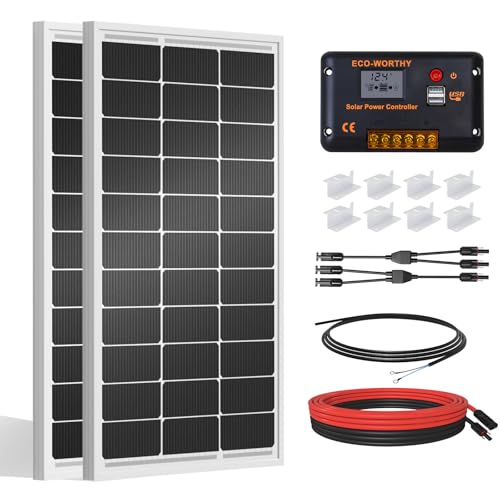
This 200W kit emphasizes higher efficiency monocrystalline panels and broad RV applicability. It promises approximately 800Wh daily under four hours of sun and includes a corrosion-resistant frame rated for wind and snow load. Best for travelers needing a compact yet reliable system with durable build quality. Caution: IP65 box and weather rating should be checked against your climate zone and mounting considerations.
Renogy 400W Premium RV Solar Kit

This high-output kit blends four 100W panels, a 40A MPPT controller, Bluetooth module, mounting hardware, and adapters. It targets RV users who want strong daily energy, especially for larger power draws like air conditioners and microwaves. Best for mid-to-large RVs or anyone needing dependable daytime power with advanced MPPT efficiency. Limitation: higher upfront cost and larger footprint than smaller 200W kits.
Renogy 200W RV Solar Kit With Adventurer Controller
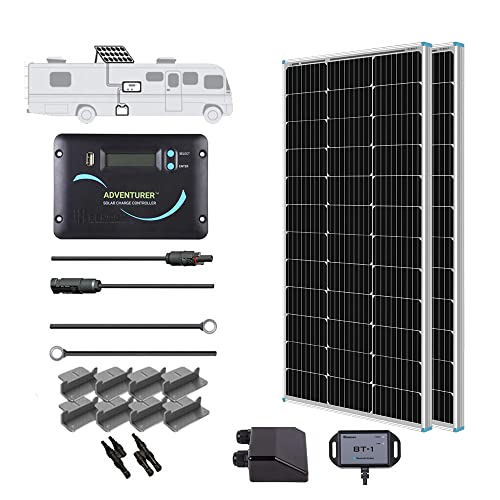
This compact kit uses two 100W panels and the Adventurer 30A PWM controller. It suits RVs that prioritize space and a simple upgrade path from a basic setup. Best for travelers with limited roof space who still want reliable daily energy. Caution: PWM controller is less efficient in varying sun conditions compared to MPPT solutions.
Buying Guide: Key Considerations for RV Solar Systems
- System size and daily energy needs: Estimate daily usage (refrigerator, lights, water heater) and choose a kit that delivers enough watt-hours per day under your typical sun. Larger RVs with A/C require more solar capacity.
- Panel quality and efficiency: Monocrystalline panels offer higher efficiency; bifacial panels can capture light from both sides but require ideal mounting.
- Charge controller type: MPPT controllers harvest more energy, especially in variable sun, but come at a higher price than PWM. For larger systems, MPPT is usually worth it.
- Battery chemistry and capacity: Lithium batteries offer longer life and deeper discharge; ensure the kit includes or supports appropriate BMS features and safe charging.
- Inverter sizing: Match inverter wattage to your load. Heavy loads (AC, microwave) need higher surge capacity and continuous wattage.
- Installation footprint and mounting: Check roof space, weight limits, and whether the kit includes mounting hardware compatible with your RV roof.
- Expandability and compatibility: Some kits are designed as modular builds for adding more panels later. Look for easy wiring, connectors, and upgrade paths.
- Weather and climate considerations: Wind and snow loads influence frame strength. IP ratings and sealing protect components in harsh climates.
Frequently Asked Questions
- What size RV solar kit do I need? Answer: It depends on daily energy use, roof space, and sun exposure. Start with a conservative estimate and choose a kit that comfortably covers peak daily needs with some reserve for cloudy days.
- Is MPPT worth it for RV use? Answer: Yes, for larger setups and variable sun, MPPT controllers extract more energy and improve charging efficiency.
- Can I upgrade an existing RV solar system later? Answer: Many kits are modular, allowing additional panels or a larger controller if the roof and electrical system can accommodate them.
- What maintenance do RV solar systems require? Answer: Check connections, inspect panels for dirt and debris, and ensure battery terminals stay clean. Batteries need periodic voltage checks and balance if LiFePO4.
- Are bifacial panels better for RVs? Answer: They can increase yield under favorable reflections, but mounting and exposure conditions matter. For RV roofs, standard monitored setups often perform reliably.
- How do I choose between PWM and MPPT controllers? Answer: MPPT is generally better for higher voltage systems and larger setups; PWM is simpler and cheaper for smaller, lower-demand kits.