Answering the question: for camping and outdoor adventures, compact, multiport power stations and inverters ensure you stay charged without lugging heavy gear. This guide highlights five versatile options suited for campers, van lifers, and emergency prep fans. Each product is evaluated for portability, output options, and practical limitations so you can pick the right balance of power and size. The table below summarizes the top picks and their best-use scenarios to help you compare quickly.
| Product | Best For | ||
|---|---|---|---|
| MARBERO Portable Power Station 88Wh | Lightweight camping trips, road trips | ~3.2 lbs | Fast charging with multiple outputs |
| Ecarke 220W Portable Power Inverter | DeWALT 20V battery users, on-the-go power | ~0.68 lb | Ultra-portable with high peak power |
| ZeroKor Portable Power Station 120W | Backpacking and short getaways | ~2.2 lbs | Multiple ports and clear display |
| DARAN Portable Power Station 89.6Wh | Low-profile emergency power and camping | ~2.5 lbs | LiFePO4 with robust output |
| HOWEASY Portable Power Station 88Wh | Three-way charging and travel | ~2.3 lbs | Three charging modes and 8 ports |
MARBERO 88Wh Portable Power Station

Best for lightweight camping and quick trips. Features include efficient charging from 0 to 80% in 2 hours using the included adapter, plus simultaneous charging for other devices. It supports MARBERO’s solar panels for outdoor use, has eight output ports, and a compact, ergonomic design that fits in a small bag. The built-in BMS ensures safety across ports. The car DC output helps run small refrigerators and air compressors in emergencies. Caution: peak draw should stay within the rated AC output to avoid overloading the unit.
Ecarke 220W Portable Power Inverter
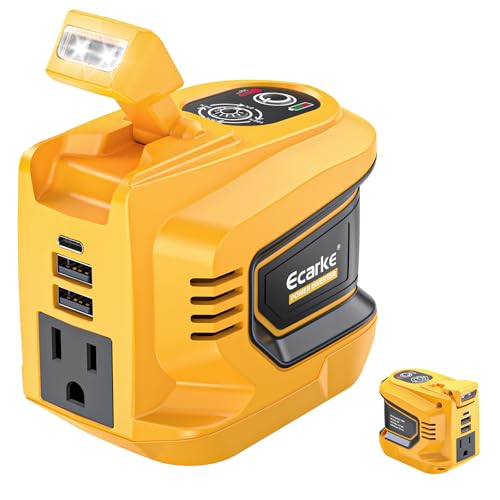
Best for Dewalt 20V battery users who need on-site 110V power. This ultra-portable unit weighs about 0.68 lb and slides onto a compatible battery for 220W continuous power (250W peak). It includes 1 AC outlet, 2 USB-A ports, 1 USB-C, and a bright LED light with three levels and SOS mode. Best for quick laptop, phone, or gadget use on a job site or campsite. Limitation: requires a compatible Dewalt 20V battery and charger sold separately.
ZeroKor Portable Power Station 120W

Best for short outdoor trips and backpack-friendly power. It offers 2x 120W AC outlets, plus DC, USB, and USB-C ports. A compact 97.6Wh capacity keeps phones, tablets, and light devices charged. It features a clear display for remaining power and charging status. Choose this if you prioritize a small footprint with multiple charging options. Caution: maximum sustained output is 120W; avoid running high-wattage devices for extended periods.
DARAN 89.6Wh LiFePO4 Power Station

Best for reliable energy with a longer lifecycle. Features a 89.6Wh LiFePO4 battery and 100W continuous, 200W peak output across seven ports, including two AC outlets, USB-C, USB-A, and DC. Fast charging enables 0-80% in about 1.5 hours. It supports multiple charging methods including AC, USB-C PD, car, and solar (panel not included). Limitation: battery type is LiFePO4; ensure compatibility with your devices and solar setup.
HOWEASY 88Wh Portable Power Station

Best for travelers needing versatile charging modes. It provides eight ports, including two AC sockets (110V, 120W with 240W peak), USB-C, USB-A, and DC outputs. Three charging modes include AC fast charge, solar panel charging, and car charging. The compact size and 6.6 x 4 x 3 inches footprint support easy transport. Caution: ensure solar panel compatibility and avoid overloading the unit with devices nearing the 120W limit.
Tenlike Portable Power Station 99.9Wh

Best for airline-conscious travelers and light backcountry use. This 99.9Wh unit powers essentials with a 80W AC limit and 120W peak for short durations. It includes Type-C PD 60W, dual USB-C PD, USB-A, and DC outputs across six ports. The compact form factor fits backpacks well, making it a solid all-around camping companion. Limitation: 99.9Wh is the airline limit; plan for devices within this capacity and avoid running high-wattage appliances for extended periods.
Buying Guide: How To Choose Your Camping Portable Outlet
- Power needs: List devices you’ll run and total their wattage. Choose a unit with continuous wattage above that sum and a comfortable peak for spikes.
- Portability vs. capacity: If you hike or backpack, prioritize lighter units with under ~3 lbs. For RV or car camping, higher capacity units trade extra weight for more outlets.
- Output variety: Look for a mix of AC outlets, USB-C PD, USB-A, and DC ports. Some devices require 12V car outputs or dedicated USB-C PD to fast-charge laptops.
- Charging options: Check if the unit supports AC charging, USB-C PD, car charging, and solar (panel compatibility varies). Three-way charging is convenient for long trips.
- Battery chemistry: Li-ion is common; LiFePO4 offers longer cycle life and stability but may weigh more. Consider climate and usage patterns when selecting chemistry.
- Durability and safety: Look for built-in battery management systems (BMS), overcharging protection, and sturdy enclosures for outdoor use.
- Expansion potential: If you plan longer trips, evaluate whether you can add solar panels for off-grid charging.
FAQ: Quick Answers For Buyers
- What size portable power station should I choose for camping?
– Choose by total device wattage and expected usage duration. A unit around 80-120Wh often covers phones, lights, and small devices, while 150-300Wh suits laptops and other essentials for longer trips. - Can I charge these with solar panels?
– Many support solar charging; confirm panel compatibility (voltage range) and whether solar is included or sold separately. - Are LiFePO4 batteries better than Li-ion for camping?
– LiFePO4 offers longer cycle life and improved thermal stability, beneficial for repeated use, but may add weight. - What is peak vs. continuous power?
– Continuous power is the steady output; peak is the short-duration surge. Ensure your device’s startup or high-wattage requirements fit within peak capacity. - Is it safe to run a laptop or small fridge from these?
– Most models support laptops and small appliances under their rated AC output. Check device wattage and avoid exceeding limits.