Answering the question of which portable propane generator is best for camping: choose a model that offers reliable dual-fuel flexibility, quiet operation, and clean power for electronics. The top picks below are ideal for campers, tailgaters, and RV travelers who want to run lights, fans, and small appliances without noise or fuel issues. Each option is selected for portability, runtime, and safety features to suit different camping styles—from ultralight backpacking with smaller loads to car-camping and RV trips.
| Product | Best For |
|---|---|
| PowerSmart 3800W Dual Fuel | Quiet campgrounds, home backup, RV use |
| Westinghouse 4650 Peak | Extended trips with RV hookups |
| ERAYAK 4500W Dual-Fuel | Compact, versatile power on the go |
| Pulsar 2700W Dual Fuel | Small electronics and light camping setups |
| WEN DF5600X | Higher wattage with quiet operation |
PowerSmart 3800 Watt Dual Fuel Inverter Generator
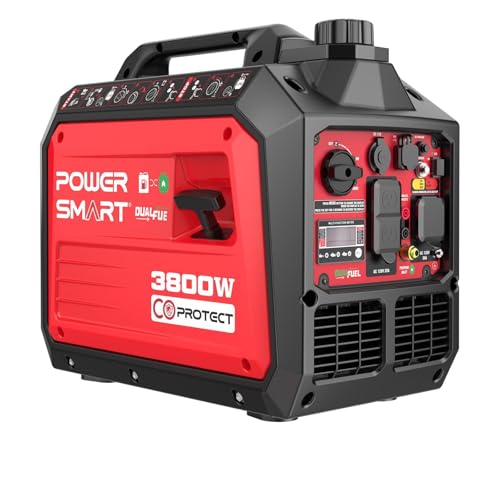
Best for campers seeking quiet operation and fuel flexibility. This model offers 3800 starting watts and 3300 running watts on gasoline, or 3500 starting watts and 3100 running watts on propane, with up to 10 hours on gas and 25 hours on propane. Its inverter design delivers clean power suitable for sensitive electronics, including CPAP machines and laptops. The unit is designed for low noise at 65 dBA, making it appropriate for quiet campgrounds or residential areas.
Who it’s best for: campers who want flexibility between gasoline and propane without sacrificing quietness or electrical integrity. Why selected: dual-fuel versatility, long propane runtime, and safe power for electronics. Caution: check fuel availability at remote campsites to maximize propane runtime.
Westinghouse 4650 Peak Watt Dual Fuel Portable Generator
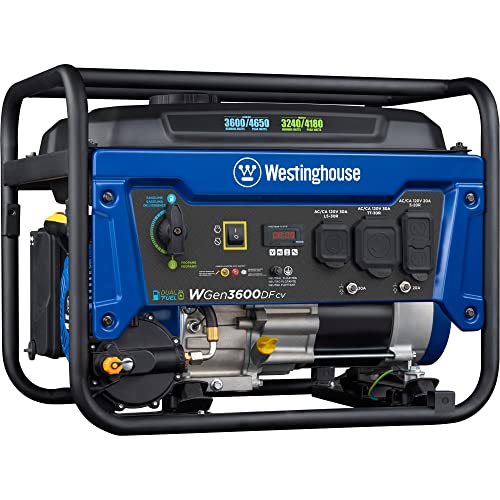
Best for extended camping trips and RV use with multiple outlets. This unit delivers 4650 peak watts and 3600 running watts on gas, and 4650 peak with 3240 running on propane. A 4-gallon fuel tank and run times up to 14 hours per tank provide extended power for longer stays. It includes a 5-20R 120V outlet, RV-ready TT-30R, and L5-30R outlets with rubber covers for safety.
Who it’s best for: campers needing reliable, RV-ready power with a longer runtime. Why selected: robust output, ample outlets, and safety features. Caution: heavier than some ultra-portable models; consider transport needs to and from the campsite.
ERAYAK 4500W Dual-Fuel Portable Inverter Generator

Best for compact power with flexible fuel choice. The ERAYAK unit supplies 4500W peak and 3500W running on gasoline, plus 4050W peak and 3150W running on propane. It is designed for easy fuel switching and portability, weighing around 54 pounds with dimensions suitable for small vehicles or storage spaces. It also supports a seamless auto-switch to gasoline if a fuel source runs out, reducing downtime.
Who it’s best for: campers who prioritize portability and reliable dual-fuel capability. Why selected: dual-fuel efficiency, auto-switch feature, and a compact footprint. Caution: propane/running time varies with load; higher loads reduce runtime.
Pulsar 2700 Watt Portable Inverter Generator

Best for compact setups and essential electronics. The Pulsar model offers 2700 peak/2200 running watts on gasoline and 2400 peak/1800 running watts on propane, with up to 6 hours runtime at half load. It includes a CO sensor and parallel capability to link with another unit for more power. The duplex plug supports common devices, making it versatile for small camps or job sites.
Who it’s best for: campers needing portable power for essential electronics and light devices. Why selected: quiet operation, CO safety, and parallel expandability. Caution: lower overall wattage compared to larger models, so plan loads accordingly.
WEN 5,600-Watt Dual Fuel Portable Generator

Best for higher-watt camping needs and backup power. This dual-fuel model runs on gasoline with 5600 surge/4500 rated watts or propane with 5000 surge/4050 rated watts. It includes electric start for quick startup and a CO watchdog to automatically shut down on dangerous gas levels. It’s suitable for longer trips where more household-style power is required.
Who it’s best for: campers needing substantial wattage for multiple devices. Why selected: higher peak power, electric start, and safety features. Caution: heavier and larger than smaller portable units; consider storage and transport constraints.
WEN Quiet Inverter 4800-Watt (DF480iX)

Best for quiet operation and sensitive electronics protection. The WEN DF480iX provides 4800 surge/4000 rated watts on gasoline and 4320 surge/4000 rated watts on propane. It emphasizes low noise and clean power to prevent damage to devices like phones and laptops. It also features a CO watchdog sensor to stop the unit if CO levels rise.
Who it’s best for: campers who need quiet, reliable power for electronics in a compact package. Why selected: quiet performance, inverter stability, and safety features. Caution: ensure the load stays within the rated continuous output for extended runtimes.
Westinghouse 2550 Peak Watt Inverter, RV Ready

Best for emergency home backup and light camping uses. This model provides 2550 peak watts and 1900 rated watts with low noise and improved fuel efficiency. It includes an RV-ready TT-30R outlet and multiple 120V/USB outlets. The economy mode helps extend runtime, making it a sensible choice for lighter loads during longer stays.
Who it’s best for: campers seeking a compact, quiet power source for essential loads. Why selected: lightweight, RV compatibility, and fuel efficiency. Caution: lower wattage means it’s not ideal for heavy appliances or high-draw devices.
Buying Guide
What to consider when choosing a portable propane generator for camping:
- Wattage needs: Estimate peak and running watts for planned devices. If you power multiple devices, prioritize higher peak watts and robust inverter clean power.
- Fuel flexibility: Dual-fuel models offer gasoline as backup when propane is scarce. Consider availability and storage of both fuels.
- Portability vs. power: Lighter units are easier to carry, but higher wattage often means more weight. Match to your vehicle, storage space, and camping style.
- Run time and tank size: Bigger tanks provide longer runtimes; propane typically offers longer continuous energy for cold or extended trips.
- Noise levels: Look for inverter generators rated around 50–65 dBA for comfortable camping experiences.
- Safety features: CO sensors, automatic shutdown, and proper outlet covers help protect occupants and equipment.
- RV compatibility: If you’re camping with an RV, ensure you have an RV-ready outlet (TT-30R) and proper adapters if needed.
- Maintenance: Check oil levels, air filters, and spark plugs per manual. Regular maintenance extends life and reliability.
Frequently Asked Questions
- What is the advantage of dual-fuel generators for camping?
Dual-fuel units offer flexibility and reduce the risk of running out of fuel by allowing propane or gasoline as power sources. - Are inverter generators safer for electronics?
Yes. Inverter models produce clean sine-wave power with low THD, safer for laptops, phones, and CPAP machines. - Is propane better for camping than gasoline?
Propane typically stores longer and remains stable; it also reduces fuel smells and is widely available in camping setups. - How loud should a camping generator be?
For most campgrounds, 50–65 dBA at 23 feet is considered quiet and campground-friendly. - Can I parallel two generators for more power?
Some models support parallel operation; check compatibility and use the correct cables and safety guidelines. - What maintenance steps are essential before a trip?
Check oil level, fuel quality, air filter, battery (for electric start), and perform a quick test run to verify operation.