Answering the search intent for portable cooling, these camping AC units are designed to keep small spaces comfortable without heavy power draw. The top picks suit different buyers: solo campers needing lightweight cooling, families requiring more BTU, RV owners seeking versatile power options, and outdoor adventurers needing quiet operation. This guide compares five compact units, highlighting who they’re best for, why they were selected, and practical limitations to consider in varying climates.
Product Overview
| Product | Best For | BTU / Power | Notable Feature |
|---|---|---|---|
| BougeRV PC35 Portable Air Conditioner | Small tents, RVs, and van life users who want app control | 3500 BTU | App control with long-range operation |
| Evapolar evaCHILL Portable Air Conditioner | Personal cooling in hot, dry climates | Evaporative cooling | Low power, portable with humidification |
| Outohome 5200 BTU Portable Tent AC | Versatile outdoor/indoor use, all-round camping | 5200 BTU | 4 modes, compact and portable |
| BODEGA Portable Tent AC 6000 BTU | Small tents and tight spaces needing real compressor cooling | 6000 BTU | Real compressor cooling for tents |
| Karinear Portable Air Conditioners, 3300 BTU | Budget-friendly, easy setup for tents and small spaces | 3300 BTU | Three modes, remote and timer |
BougeRV PC35 Portable Air Conditioner
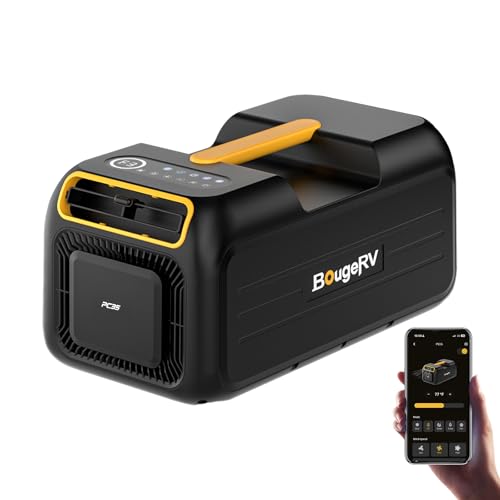
Best for: Solo campers or couples needing quick, compact cooling with smart control. This unit can drop temperatures notably in small spaces up to 64.58 ft². It supports app management within 33 ft, enabling you to adjust temperature and modes without leaving your seat. The ergonomic handle adds portability for both indoor and outdoor setups. A limitation is the cooling capability is tailored to smaller areas; expect limited effectiveness in larger tents or outdoor spaces.
Evapolar evaCHILL Portable Air Conditioner

Best for: Personal cooling in hot, dry climates where evaporative cooling is effective. This device uses humidification alongside cooling to deliver a breeze within 3–5 feet. It’s energy-efficient at about 10W and works well with or without a larger AC system. Note that performance depends on ambient humidity; higher humidity can reduce effectiveness.
Outohome 5200 BTU Portable Tent AC

Best for: Campers needing a balanced, medium BTU solution with portability. With 5200 BTU cooling and four modes (Cooling, Dehumidifying, Sleep, and Fan), this unit targets both cooling and comfort in small spaces. A potential drawback is its weight relative to ultra-light backpacking gear, making it more suited to vehicle-based camping.
BODEGACOOLER Portable Tent AC 6000 BTU

Best for: Campers in small tents needing real compressor cooling in a compact footprint. The 6000 BTU rating supports spaces around 32–54 ft². Four modes (Cooling, Fan, Sleep, Dehumidifier, plus Max Cool) help adapt to changing outdoor conditions. Limitations include size and weight, which are less ideal for ultra-light backpackers.
Karinear Portable Air Conditioners, 3300 BTU

Best for: Budget-conscious buyers seeking a compact, easy-to-use unit for 30–62 ft² spaces. It cools to around 60°F in a short time and includes three modes plus a remote and timer. The lower BTU means it’s best for smaller tents or RV compartments; expect cooler performance in very hot conditions.
Buying Guide: Key Considerations For Camping AC Units
Space size and BTU requirements: Choose BTU not just by space size, but by how well the space traps heat. Portable tent spaces typically require 3000–6000 BTU depending on enclosure size and insulation.
- Power sources: Look for ACs with 110V compatibility or multi-power options (vehicle or 12V/24V) for flexibility in RVs or campsites.
- Noise level: For sleeping areas, prefer units marketed as quiet or with a low dB rating.
- Modes and efficiency: Modes like Dehumidify, Sleep, and Eco+ can extend battery life and reduce noise.
- Portability: Consider weight, handles, and whether the device can be carried with one hand or needs two.
- Humidity and climate: Evaporative coolers work best in dry environments; compressor-based units perform consistently in humid or variable climates.
Frequently Asked Questions
- What size camping AC is best for a tent?
Most tents benefit from 3000–6000 BTU units, depending on tent size and insulation.
- Can camping ACs run on battery power?
Some models offer 12V/24V or DC options, but most require a AC power source or external power stations.
- Are evaporative coolers suitable for camping?
Yes, in dry climates they are energy-efficient, but humidity reduces effectiveness.
- Is a higher BTU always better?
Not necessarily; a unit with too much BTU for a small space can overcool and waste energy.
- What should I consider for RV use?
Power availability, ventilation, and ducting fit are key. Look for multi-power compatibility and compact size.