Looking for a lightweight sleeping pad to boost comfort without weighing you down on multi-day trips? This guide reviews five ultralight options that balance packability, warmth, and durability for backpackers. Each pick targets a different type of buyer—from ultralight hikers to casual campers—so you can choose the best fit for your adventures. Below, compare features, best-use scenarios, and any practical limitations to help you decide.
Quick reference: chosen products at a glance
- Gear Doctors Ether 17.5oz Ultralight — Best for ultralight hikers who want a compact, high-capacity air pad
- TREKOLOGY Ultralight — Best all-round inflating pad with good warmth retention
- FlexRest Pro Insulated — Best for cold-weather trips with strong insulation
- Therm-a-Rest Z Lite Original — Best budget-friendly, durable foam pad
- FUN PAC Camping Pad with Pillow — Best for quick setups and built-in comfort accessories
Gear Doctors Ether Ultralight Sleeping Pad

The Gear Doctors Ether 17.5oz pad compresses to the size of a water bottle and inflates to a large 76″ x 25″ platform with Ergonomic contours. It supports up to 440 pounds and includes a detachable foot pump for quick inflation. A rugged 20D Nylon with water-resistant TPU delivers durability in damp or rough conditions. This pad is best for ultralight backpackers who value compact storage, quick setup, and a higher weight capacity, making it suitable for a wide range of body types and terrains. A potential limitation is the reliance on the included pump for the fastest setup, which may be less convenient in wet or cold environments.
Best for: Ultralight hikers seeking a compact, high-capacity sleeping pad without sacrificing comfort on longer treks.
TREKOLOGY Ultralight Backpacking Sleeping Pad

At 4 inches thick and 750 grams, the TREKOLOGY pad features raised sides and S-curve channels to stabilize sleepers and lift them 4 inches off cold ground. It measures 75.2 inches long and 22.4 inches wide, suitable for most adults up to about 6.1 feet. It inflates by mouth or can use a standard pump (sold separately). The compact design, with a small pack footprint, makes it a solid choice for hikers who want a straightforward inflate-and-go pad without heavy insulation needs. Its main limitation is the need for inflation by mouth or an optional pump, which may be slower in cold conditions.
Best for: Backpackers who want a balance of comfort and low weight, with easy-inflation features and reliable support for multiple sleeping positions.
FlexRest Insulated Sleeping Pad

The Pro Insulated Sleeping Pad from FlexRest is ultralight and compact, featuring a mummy-style design to minimize heat loss. It provides an ASTM R-value of 4.9, delivering strong cold-weather insulation. This pad is best for winter trips or shoulder-season adventures where warmth is essential without a heavy pack. A potential drawback is the slightly higher price point and a more tailored fit that may not suit all body shapes equally.
Best for: Cold-weather hikers needing reliable warmth in a lightweight, compact package.
Therm-a-Rest Z Lite Original Pad

The Z Lite Original uses closed-cell foam with accordion-style folding for compact storage and durable performance. It traps heat with dimples in the padding and is a classic, economical option for ground sleep. Its R-value is 1.7, making it suitable for mild-to-warm conditions or as a backup pad in colder weather. The main limitation is its bulkier feel compared with air pads and less overall comfort for side sleepers on extended trips.
Best for: Budget-conscious trekkers and mountaineers seeking a rugged, maintenance-free pad with proven reliability.
FUN PAC Camping Sleeping Pad With Pillow
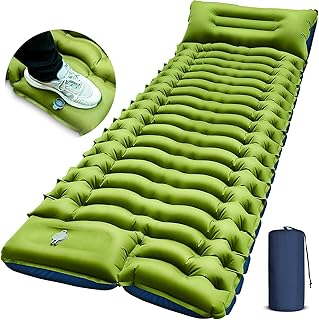
The FUN PAC pad features an extra-wide 78″ x 27″ surface and 3″ of thickness, plus a built-in pillow and quick-inflate pump. It inflates in 30–60 seconds and deflates in about a second, with an upgraded valve designed to minimize air leaks. Its built-in pillow reduces the need to carry separate items, appealing to minimalist setups. A caution is that the self-inflating mechanism may vary in effectiveness in extremely cold environments, and storage of the built-in pump may affect pack space for ultra-light trips.
Best for: Campers and hikers who prioritize an all-in-one comfort solution with fast setup and built-in head support.
Buying Guide
What matters most when choosing a backpacking sleeping pad?
- Insulation and warmth: Consider R-value or overall warmth, especially if you camp in cool or variable conditions. Insulated pads provide better protection against ground chill.
- Weight and packability: Ultralight pads reduce carried weight but may compromise comfort or durability. Balance weight with your trip length and terrain.
- Inflation method: Self-inflating, pump-assisted, or manual inflation each have trade-offs for speed and convenience. Pumps are great in damp conditions; mouth inflation is simple but slower.
- Durability and material: Nylon with TPU coatings vs closed-cell foam. Decide based on expected terrain, moisture exposure, and maintenance willingness.
- Comfort and sleeping position: Side sleepers may prefer thicker pads; stomach sleepers might prioritize center-to-edge stability and comfort.
- Width and length: Ensure the pad fits your body size and your tent footprint. Wider pads improve comfort on uneven ground.
Frequently Asked Questions
- Q: Do I need a pad with a high R-value for summer camping? A: Not necessarily; for warm nights, a lighter, thinner pad may suffice, but it depends on ground temperature and personal comfort.
- Q: Is it better to choose foam or air pads? A: Foam is durable and silent with no pump needed; air pads are lighter and more compact but require inflation and potential leaks.
- Q: Can I use a pad inside a tent with a groundsheet? A: Yes, pads are commonly used with tents and can be paired with footprint or groundsheet for added protection.
- Q: How do I store a compressed air pad to extend life? A: Deflate fully after use, store in a dry, cool place, and avoid prolonged exposure to direct sun or sharp objects.
- Q: Which pad is best for side sleepers? A: Pads with thickness and width that support hip and shoulder alignment are preferable; look for models near 3–4 inches thick.
- Q: Are inflatable pads worth extra weight for warmth? A: In many cases, yes, since insulation is often lighter than equivalent foam pads and provides better warmth-to-weight ratios.