Whether you’re cruising full-time or taking weekend getaways, a reliable caravan hot water heater is essential for comfortable showers, dishes, and general convenience. This guide highlights five top options that balance power, capacity, and practicality for RV living. It targets buyers who want dependable performance in remote campsites, family trips, or compact living spaces. The following table compares key specs to help you choose quickly.
| Product | Capacity | Power (W) | Best For | Notes |
|---|---|---|---|---|
| FVSTR Dual Power Water Heater | 10 L | 200W / 1500W | Caravans with variable power access | Dual power supply for DC or AC use |
| VEVOR 10 Gallon Electric Water Heater | 40 L | 1600W | Families needing steady supply | LED display; enamel coating |
| VEVOR 12 Gallon Electric Tank Water Heater | 12 Gal | 1600W | Small apartments or remote water points | Insulated with T&P protection |
| ORBEK RV Tankless Water Heater | On-demand | 60,000 BTU/min equiv. | Busy RV families needing instant hot water | Propane on-demand with remote |
| LDEXIN 1-1/2″ Thread Electric Water Heater Tube | N/A | 6000W | Replacement heating element needs | Stainless steel element for durability |
FVSTR Dual Power Water Heater — 10L, 12V/120V

The FVSTR Dual Power Water Heater provides both DC 12V (200W) and AC 120V (1500W) options. This flexibility suits remote camps, mobile caravans, or standard hookups, enabling stable hot water supply under varying power conditions. The built-in 10-litre tank supports continuous use by multiple occupants without frequent refills. A sturdy shell offers pressure resistance for diverse environments. Best for: travelers who shift between off-grid sites and powered campsites, or those who want a compact, dual-supply solution. Caution: ensure correct power mode selection to maximize efficiency and safety in your setup.
VEVOR 10 Gallon Electric Water Heater

This 10-gallon unit delivers 1600W of heating power and features an extended immersion element for rapid hot water delivery. An LED display and knob control simplify temperature adjustments from 30℃ to 75℃. An enamel coating adds safety against burns and leaks, while core protections guard against overheating and overpressure. Best for: families or groups who need a steady supply of hot water for showers, dishes, and laundry with straightforward controls. Caution: ensure proper venting and electrical supply in your RV setup.
VEVOR Electric Tank Water Heater — 12 Gallon

This 12-gallon design targets small apartments or remote water points in RV living. It uses 1600W for fast heating and keeps water temperature stable with high-quality insulation. The unit includes a side outlet, T&P valve, and IPX4 rating for safety in damp environments. Best for: solo travelers or couples who want a compact tank heater that fits tight spaces while delivering reliable hot water. Choose this if you prioritize insulation and safety features over ultra-fast heating.
ORBEK RV Tankless Water Heater
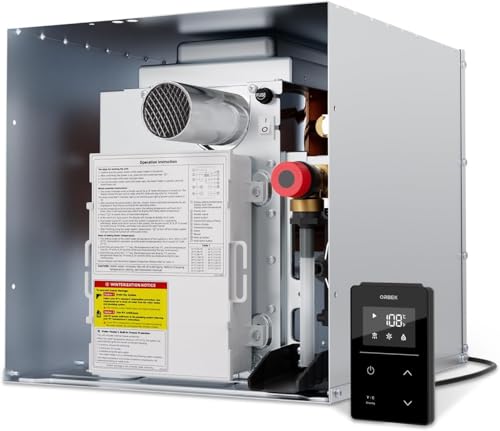
The ORBEK RV Tankless Water Heater provides instant hot water with 60,000 BTU per minute, activating only when needed to conserve propane and energy. It uses oxygen-free copper heat exchangers and brushless DC fans, adapting to high altitudes and cold starts. This system is ideal for busy RV families that demand continuous hot water without waiting for a tank to heat. Best for: RVers who value on-demand performance and energy efficiency. Limitation: installation requires appropriate space and setup for venting and clearances; dimensions vary by model.
LDEXIN 1-1/2″ Thread Electric Heating Tube

This stainless steel heating element is designed to resist corrosion and scale buildup, extending the life of RV water heating systems. The 1-1/2″ thread size fits compatible tanks and boilers, providing robust heat transfer. Best for: DIY refinements or replacements where a high-durability heating element is needed. Caution: verify compatibility with your model before purchase to avoid mismatches.
Buying Guide: How To Pick The Right Caravan Hot Water Heater
What capacity do you need?
- Single-person use: 6-10 liters can suffice for quick showers and dishwashing.
- Small family or dual outlets: 10-20 liters balances supply with faster recovery times.
- Higher demand: 20+ liters or tankless options help keep up with multiple outlets.
What power source fits your setup?
- Dual power (DC and AC) offers flexibility for off-grid and plugged-in scenarios.
- High-wattage electric units require a robust electrical system and adequate shore power.
- On-demand propane tankless heaters save space but need proper venting and clearance.
Tankless vs. tank styles?
- Tankless: continuous hot water, no standby losses, but installation complexity can be higher.
- Tank units: easier to install in limited spaces, consistent if you have a steady power source.
Safety and durability considerations
- Look for IP ratings, T&P valves, and corrosion-resistant interiors for RV environments.
- Enamel coatings and magnesium anodes help extend life in mineral-rich water.
- Ensure compatibility with your RV’s electrical system and fuel type if considering propane models.
Frequently Asked Questions
- What size RV water heater do I need for a family? A: For a family, consider 10-20 liters or a 12-20 gallon tank, or a tankless unit with high flow if multiple outlets are used simultaneously.
- Can I install a tankless heater in an older RV? A: Yes, but it requires proper venting, space, and compatibility with propane or electric supply.
- Is dual power a better option? A: Dual power offers flexibility for varying power access, which is common on campsites.
- Should I choose a tank heater or tankless for off-grid use? A: Tankless saves space and energy when you have adequate power, but tank heaters are simpler to install and maintain in some setups.
- What maintenance is needed? A: Regular descaling, checking valves, and inspecting insulation help prolong performance and efficiency.
- Are these RV heaters safe for saltwater regions? A: Choose units with corrosion-resistant interiors and proper sealing; use water-conditioning advice as needed.