Answering the question, these flexible solar panels offer portable, reliable charging for camping and off-grid adventures. They’re suited for hikers, campers, RV travelers, and emergency prep, with options optimized for different devices and power stations. This guide compares five top picks, highlighting who each product is best for and why. Review includes standout features, portability, and practical caveats to help you choose.
| Product | Best For | Why It Stands Out |
|---|---|---|
| FlexSolar 100W Foldable Portable Solar Panel | Lightweight travelers needing USB-C PD and multiple outputs | High efficiency, 3-in-1 outputs, very portable |
| 200W Portable Solar Panel (TWELSEAVAN) | Power users with larger power stations | High conversion, multi-port fast charging |
| ZOUPW 100W Portable Solar Panel | Off-grid families and campers with broad compatibility | IP67/ETFE coating, true 5-in-1 connectors |
| 60W Portable Solar Panel | Compact backpacking and hiking setups | Ultra-portable, rugged mounting options |
| 100W Flexible Foldable Solar Panel (General) | Lightweight flexibility with decent efficiency | Flexible build, IP65 waterproofing |
FlexSolar 100W Foldable Solar Panel Charger

Best for travelers seeking a compact yet capable power source. This 100W panel folds to a slim profile and weighs 4.1 lbs, making it easy to pack in a backpack or bag. It includes a premium carry bag for organized transport, and its large unfolded area supports robust solar capture for camp gear and small power banks.
Best for: campers who want PD 3.0 USB-C, QC3.0 USB-A, and a DC port in one unit. The 45.47 x 26.18″ unfolded size helps with faster charging in moderate sun. Caution: performance depends on sun angle and weather; the 23%+ efficiency is best in bright conditions.
200W Portable Solar Panel for Power Station
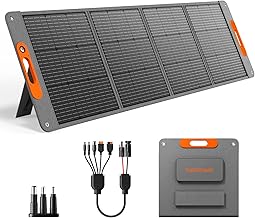
Best for advanced setups requiring higher output to top up larger power stations. The 200W panel uses 24%+ efficiency monocrystalline cells with ETFE protection and a long MC4 cable. It supports multiple adapters and fast charging via USB-C and USB-A ports.
Best for: users with Jackery, EcoFlow, Bluetti, or similar systems who need robust, simultaneous charging. Limitation: heavy compared to smaller panels, so consider transport and mounting needs for backpacking.
ZOUPW 100W Portable Solar Panel

Best for rugged outdoor use and broad device compatibility. This 100W panel uses 23.5% efficiency monocrystalline cells and IP67 waterproof ETFE coating. It offers a true 5-in-1 universal connectivity that fits many popular power stations without extra adapters, plus a durable, weather-ready pocket.
Best for: campers who value universal connectors and higher water resistance for unpredictable environments. Caution: ensure the included connectors are compatible with your specific power station model to avoid adapter issues.
60W Portable Solar Panel

Best for minimalist, lightweight setups such as short hikes or quick weekend trips. Weighing about 4.18 lbs, this 60W panel folds compactly and includes mounting options like carabiners and a magnetic mount for tents or backpacks.
Best for: travelers prioritizing ultra-portability and quick setup. Limitation: lower wattage means slower charging for larger devices or multiple devices in dim light.
100 Watt Portable Flexible Foldable Solar Panel

Best for flexible installation and all-around outdoor use. Made with high-efficiency A+ monocrystalline cells and IP65 waterproofing, this panel remains durable under varying weather. It folds for easy carrying and includes a robust lamination coating for light transmission up to 95%.
Best for: RVs, tents, and flexible mounting on uneven surfaces. Caution: while flexible, ensure proper support for the panel to avoid creasing the protective layers in heavy handling.
Buying Guide
- Power needs vs. portability: Larger panels like 200W deliver more power but weigh more. For single-device charging on a weekend, 60W–100W models offer a balance of weight and output.
- Outdoors compatibility: Look for IP or IP67/IP65 ratings, ETFE coating, and robust laminations to withstand rain, dust, and abrasion.
- Connector options: Choose panels with wide compatibility or 5-in-1 cables to fit most power stations without extra adapters.
- Output ports: If USB-C PD is important, verify PD60W or higher and USB-A for older devices. Some panels provide DC outputs for power stations as well.
- Portability features: Folding designs, lightweight weight, included carry bags, and mounting accessories improve field use.
- Durability vs. flexibility: Flexible panels excel on uneven surfaces but ensure the build supports repeated folding and unfolding without damage.
Frequently Asked Questions
- What is the best solar panel for camping with a power station? Look for high-efficiency monocrystalline cells, true 5-in-1 cables for compatibility, and PD USB-C outputs for fast charging.
- Do flexible panels perform well in cloudy weather? They still generate power, but output drops with light. High-efficiency cells help in partial sun conditions.
- Are IP67/IP65 ratings necessary? Yes, for camping and RV use where panels may face rain, dust, or splashes.
- Can I charge multiple devices at once? Many panels offer USB-C PD, USB-A, and DC outputs to power several devices simultaneously.
- How should I store a foldable solar panel? Fold it carefully in its carry bag and avoid sharp creases to extend life.
- What should I consider when choosing a panel? Prioritize compatibility with your power station, required output (watts), weight, and environmental durability.