Answering the search for reliable underwater illumination, this guide highlights five LED diving hand torches that balance brightness, depth rating, and ease of use. Each pick suits a different diver profile—from recreational night divers to tech-heavy wreck explorers. The list below helps you match beam distance, battery access, and mounting style to your needs, with clear reasons to choose or avoid each option.
| Product | Why It Stands Out |
|---|---|
| WINDFIRE Dive Light | Long reach, 150 m beam; three modes; robust IPX8 aluminum body; best for deep or murky water |
| Wurkkos DL30 | High brightness 3600 lm; strong 240 m range; long runtime on Low; great for wrecks |
| ORCATORCH D560 Mini | Compact, 360° mask clip; ultra-light; ideal for hands-free close work |
| ORCATORCH D550 | Powerful 1000 lm; wrist-mount included; good balance of brightness and hands-free use |
| ORCATORCH Diving Glove Holder | Hands-free accessory for securing a light; no torch included; best as a mount/backup option |
WINDFIRE TS08 Dive Light Review

This flashlight uses a 5500K white beam designed to restore natural underwater colors and cut through murky water. It has a 12° focused beam that reaches up to 150 meters, making it a strong choice for divers who frequently explore dim or deep sites. Three lighting modes (High, Low, SOS) provide flexible brightness for varying conditions. A built-in power indicator helps you monitor remaining charge. The housing is aerospace-grade aluminum, delivering corrosion resistance and rugged construction for tough dives. Best for: divers who need a bright, reliable beam at depth and value clear color rendering. Caution: battery life indicators are helpful, but plan for a mid-dive recheck to avoid surprises in long excursions.
Wurkkos DL30: High-Output Deep-Sea Light
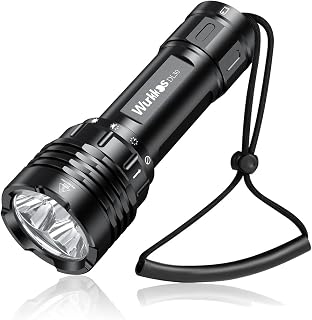
The DL30 delivers up to 3600 lumens with a focused beam reaching 240 meters. Its IPX8 rating indicates strong water protection, suitable for deep or technical dives. Three brightness levels (Low, Medium, High) are selectable via a magnetic control ring, offering up to about 5 hours 52 minutes of runtime on Low. This makes it a solid choice for divers who want high brightness with substantial endurance and simple, intuitive operation. Best for: wreck and night divers who require robust illumination and steadier power management. Caution: higher brightness consumes more battery life; monitor battery level on long trips.
ORCATORCH D560 Mini: Small But Capable

The D560 Mini is a compact 92 mm light that weighs about 47.5 g, designed for close-up observation and instrument work. It comes with a 360° MX05 mask clip, enabling hands-free positioning on the dive mask, which is convenient for precision tasks. It suits divers who want a lightweight backup or a primary light for shallow, night, or cave dives where minimizing bulk matters. Best for: divers who value hands-free operation and a lightweight setup. Caution: not sold with standalone batteries, so you must source compatible power separately.
ORCATORCH D550: Hands-Free Power

The D550 delivers up to 1000 lumens with a wrist-mount provided in the package, enabling hands-free operation while keeping light focused on the underwater area you’re inspecting. It is designed for night or cave diving, where bright, stable illumination is essential. Best for: divers who want strong output with the convenience of a wrist mount. Caution: as with some models, batteries may not be included; verify power setup before travel.
ORCATORCH Glove Mount: Light-On-Hand Accessory

This glove-style holder is designed to secure a flashlight to your hand, freeing both hands for tasks. The strap works with lights that are between 24 mm and 28 mm in diameter and weighs about 40.7 grams. It is suitable as a hands-free accessory for divers who regularly manipulate gear underwater. Best for: divers who want reliable light access while performing equipment work or photography. Caution: this is an accessory and not a light itself; select a compatible torch for use with this holder.
Buying Guide: Key Purchase Considerations
- Beam distance and color accuracy: For color restoration and clarity in murky water, look for a 5500K or similar white light and a beam that reaches at least 150–240 meters.
- Depth rating and waterproofing: Prioritize IPX8 or better for reliable operation beyond basic immersion. Consider materials like aerospace-grade aluminum for corrosion resistance.
- Power source and runtime: Decide between rechargeable battery packs and disposable options. Longer runtime is crucial for extended night or wreck dives.
- Mounting and handling: Hands-free use (mask clip, wrist mount, or glove strap) can improve safety and efficiency on technical dives.
- Size and weight: Compact lights reduce drag and are easier to carry, but ensure they still deliver sufficient brightness for your needs.
- Battery data and indicators: Real-time power indicators help plan recharges and prevent mid-dive failures.
Practical Questions to Consider
- What is my primary diving environment: night dives, wrecks, or caves?
- Do I need hands-free operation or maximum brightness at the expense of size?
- Are standalone batteries required, or will I rely on rechargeable packs?
- How important is a long beam distance versus compact form factor?
FAQ
- What beam distance is typical for deep-water dives? – Most good diving lights provide effective illumination up to 150–240 meters, depending on the model and beam design.
- Do I need a separate battery for a dive light? – Some models include rechargeable batteries, while others require you to purchase batteries separately. Check the product listing.
- Is hands-free lighting necessary for night dives? – It can improve safety and task efficiency by freeing both hands for equipment checks or photography.
- Can I use a standard flashlight for diving? – No, standard flashlights are not designed for underwater pressures and may flood or fail. Use purpose-built dive lights with appropriate seals.
- Which feature matters most for wreck diving? – A bright, long-range beam with reliable waterproofing and secure mounting options is typically most beneficial.
- Are mask-clip lights durable? – Yes, but consider the clip’s stability and whether it fits your mask well to avoid misalignment during dives.