Find reliable long-term survival kits designed to stock your pantry, bug-out bag, or emergency shelter. This guide highlights five top options and explains who each is best for. Whether you’re building a home stockpile, prepping for hiking or camping, or equipping a family for extended outages, these kits offer extended shelf life, easy preparation, and scalable storage. The list emphasizes practical use, clear benefits, and realistic trade-offs so you can compare at a glance.
| Product | Servings / Size | Shelf Life | |
|---|---|---|---|
| ReadyWise Emergency Food Supply – 120 Servings | 120 servings | Up to 25 years | Freeze-dried meals for long-term storage |
| 4Patriots Emergency Entree Kit – 128 Servings | 128 servings | Up to 25 years | Freeze-dried entrees with extended shelf life |
| ReadyWise Emergency Food Supply – 360 Servings | 360 servings | Up to 25 years | Multiple buckets of entrées and breakfasts |
| Augason Farms 45 Days Emergency Food Supply Kit | 281 servings (approx. | Up to 25 years | Dehydrated meals with varied varieties |
| ReadyWise 7 Day Emergency Food Supply | 60 servings | Up to 25 years | Grab bag with breakfasts and entrées |
ReadyWise Emergency Food Supply – 120 Servings

Best for individuals who want a compact, ready-to-use starter kit. This 120-serving bucket provides variety and long shelf life, suitable for a single household or a minimalist prepper. The split lid design enables quick access to pouches, which helps during power outages or quick meal needs. It is especially practical for beginners who prefer a simple, scalable approach to long-term storage. A potential limitation is that it represents a single-bucket solution, which some preppers may want to supplement for extended outages.
4Patriots Emergency Entree Kit – 128 Servings

Best for families seeking menu variety and long-term resilience. This kit emphasizes seasoned entrees with a full 128 servings, designed to keep energy and nutrients steady during emergencies. It uses triple-layer Mylar packaging with an oxygen absorber to protect against air, light, and moisture. Choose this if you want familiar meals like Mac and Cheese or Stroganoff. A caveat is that the kit focuses on entrees, so you may want additional breakfasts or snacks for round-the-clock needs.
ReadyWise Emergency Food Supply – 360 Servings

Best for larger households or for diversifying a long-term pantry. The 360-serving kit adds more meals and breakfasts, still maintaining up to 25 years of shelf life. Its stackable buckets and a split-lid design simplify storage and quick meal access. It’s well-suited for households that want a broader assortment without purchasing multiple smaller kits. A limitation is the larger volume, which requires more storage space.
Augason Farms 45 Days Emergency Food Supply Kit
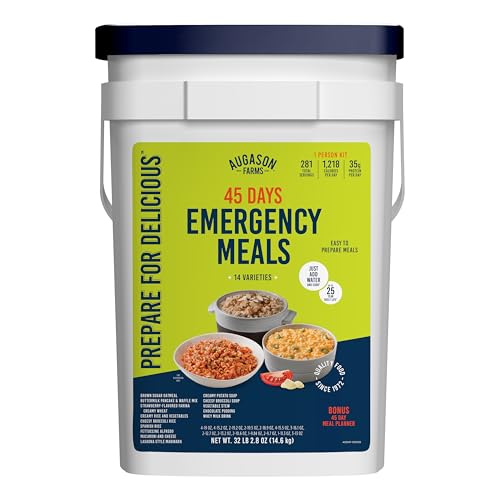
Best for a longer, varied 45-day emergency plan for one person. With 281 servings and a 25-year shelf life, it provides a broad mix of meals and convenience. Just add water and heat, making it accessible for those with simpler cooking setups. A consideration is that this kit focuses on one-person planning; larger households may need additional meals or mixes to cover all days equally.
ReadyWise 7 Day Emergency Food Supply

Best for short-term outages or travel-ready bug-out bags. This 60-serving grab bag emphasizes portability and quick access, with a shelf life of up to 25 years. It’s ideal for adding a compact, travel-friendly option to a broader long-term plan. A limitation is that its smaller size may require more frequent restocking for longer emergencies.
Buying Guide: Key Purchase Considerations
- Shelf Life and Storage Space: Most long-term kits offer up to 25 years. Plan storage in a cool, dark place and consider stackable containers to maximize space.
- Meal Variety vs. Quantity: Larger kits provide more menu variety, while smaller kits offer easier handling. Balance your family’s taste preferences with total servings.
- Preparation Needs: Some kits require only water; others may need cooking. Choose based on your available cooking equipment and time during emergencies.
- Packaging and Protection: Look for Mylar packaging, oxygen absorbers, and robust sealing to protect against moisture and light.
- Portability: If you need bug-out capabilities, prioritize grab-and-go formats with sturdy handles and compact design.
FAQ for Long-Term Survival Kits
- What is the typical shelf life of freeze-dried emergency meals? Up to 25 years, depending on storage conditions.
- How many servings should a family start with? Aiming for 1,000–2,000 calories per person per day across 72 hours is a common baseline; adjust for family size and climate.
- Are these kits ready to eat? Many are ready-to-cook or require only water; check each product’s preparation steps.
- Should I mix brands or keep a single-brand strategy? Mixing brands can diversify flavors and nutrient profiles; pairing one comprehensive kit with a few specialty packs often works well.
- How do I rotate stock effectively? Use a first-in, first-out approach; label dates clearly and plan annual or semi-annual rotation during non-emergency periods.
- What about first aid or shelter gear? Most survival kits focus on food; consider pairing with separate first aid kits and shelter tools for a complete readiness plan.