If you need dependable off-grid power, an off-grid kit is your best choice for RVs, cabins, or remote sheds. This guide highlights five solid options from ECO-WORTHY and a practical off-grid book to widen your planning toolkit. Each entry explains who benefits most, why it’s selected, and a clear limitation to consider. Use this to compare setup complexity, daily output, battery type, and expandability.
| Product | Best For | Why It Stands Out |
|---|---|---|
| ECO-WORTHY 200 Watt 12V Complete Solar Panel Starter Kit for RV Off Grid | New RVers | Comprehensive starter system with everything included for quick setup |
| ECO-WORTHY 200 Watts 12 Volt/24 Volt Solar Panel Kit | Owners seeking higher efficiency | High-efficiency monocrystalline panels and durable frame |
| 100W Solar Panel Kit 12V Battery Maintainer | Seasoned DIYers | Compact, maintainable kit for keeping batteries topped off |
| ECO-WORTHY 1.6KWH Complete Solar Panel Kit 400W 12V | Full-home backup | Higher daily output with lithium battery and long life |
| No Grid Survival Projects (Book) | Researchers and planners | Practical off-grid concepts and planning guidance |
ECO-WORTHY 200 Watt 12V Complete Solar Panel Starter Kit for RV Off Grid

This complete 200W RV solar kit is designed for off-grid use with a simple 4-step install. It includes two 100W solar panels, a 12.8V 100Ah lithium battery, an 1100W inverter, a 30A PWM controller, and all cables. Best for first-time RV owners who want an all-in-one package and quick setup, with a focus on hassle-free compatibility.
Best for: RV travelers who want a plug-and-play power system with bundled components for immediate use. The 4-step install aims to minimize DIY hurdles. A potential limitation is that expansion beyond the included components may require additional purchases.
ECO-WORTHY 200 Watts 12 Volt/24 Volt Solar Panel Kit with High Efficiency Monocrystalline Solar Panel and 30A PWM Charge Controller for RV, Camper, Vehicle, Caravan and Other Off Grid Applications

Offers wide application, delivering about 800Wh per day under ideal sun and 4 hours of full sun. The kit uses high-efficiency mono panels and a corrosion-resistant frame, designed to withstand wind and snow loads. Best for RVs, campers, or cabins needing reliable daily output with robust durability.
Best for: Those who want a higher efficiency panel setup with a sturdy frame and IP65-rated protection. Better for higher-output needs in moderate climates; a limitation is that actual daily output depends on sun conditions.
100W Solar Panel Kit 12V Battery Maintainer

This compact 100W panel kit paired with a battery maintainer is ideal for ongoing battery upkeep in off-grid systems. The kit is better for volunteers or seasonal setups where intermittent charging is needed and space is limited. A caveat is that it may not deliver multi-day autonomy without additional storage or larger panels.
ECO-WORTHY 1.6KWH Complete Solar Panel Kit 400W 12V for RV Off Grid
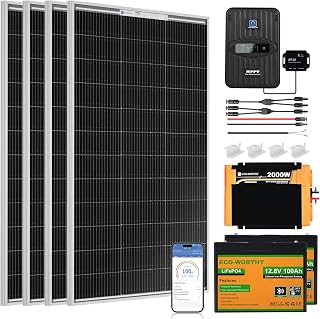
This kit targets larger off-grid needs with about 1.6KWh daily output under ideal conditions and 400W solar power. It’s suitable for powering AC devices (under 2000W) in RVs or small cabins, with options to boost energy generation via a dual-axis tracker or mounting brackets. The lithium-based system includes a BMS for battery health management.
Best for: Off-grid setups requiring higher daily energy and occasional power-hungry devices. Choose this if you plan extended stays or higher load appliances; avoid if you need a smaller, simpler system for limited space or budget constraints.
No Grid Survival Projects
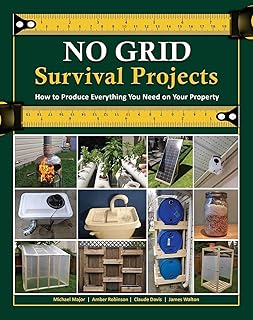
This book covers practical off-grid concepts and planning strategies. It is best for readers researching long-term independence, resilience, and backup power planning. A limitation is that it is not a hardware kit and does not provide installable components or direct system integration details.
Buying Guide: Key Considerations For Off-The-Grid Kits
- Daily power needs: Estimate watts used by essential appliances to choose appropriate panel wattage and battery capacity.
- System type: Decide between all-in-one kits for quick setup or modular kits for scalable expansion.
- Battery chemistry: Lithium offers higher cycle life and faster charging but may cost more upfront than lead-acid.
- Climate and mounting: Consider wind and snow loads, corrosion resistance, and mounting flexibility in harsh environments.
- Expandability: If you anticipate growth, select systems with easy add-ons like extra panels, controllers, or inverters.
- Maintenance: Evaluate controller and battery maintenance needs, especially for off-grid longevity.
- Installation complexity: Some kits are novice-friendly; others assume DIY experience for wiring and safety.
Frequently Asked Questions
- What is the typical daily output of a 200W solar kit?
– About 800Wh per day under good sun conditions; actual output varies with location and weather. - Is lithium better than lead-acid for off-grid kits?
– Lithium batteries offer longer life and deeper discharge tolerance but can be pricier upfront. - Can I expand a kit later?
– Many kits support expansion with extra panels, controllers, or batteries, but verify compatibility. - What is a PWM controller?
– A PWM controller manages charging from panels to the battery; it’s common in entry-level kits and less efficient than MPPT in some conditions. - Which kit is best for RV beginners?
– The 200W complete starter kit is designed for quick setup and novice-friendly installation. - What should I consider for off-grid safety?
– Ensure proper wiring, fusing, ventilation for battery storage, and adherence to local electrical codes.