Answering the top buyer question: which leveling solution best stabilizes a pop‑up camper on uneven ground? This guide compares five popular options for various needs, from heavy‑duty stabilizers to stackable leveling blocks. The best pick depends on your camper weight, terrain, and whether you need leveling only or height adjustment. The top products below are chosen for their strength, versatility, and installation practicality for common American RV setups.
Summary table of selected products:
| Product | Best For | Height Range | Material |
|---|---|---|---|
| Kohree 7500lbs Stabilizers (2-Pack) | Heavy campers needing robust leveling | 4″ retracted to 24″ height | Heavy‑duty steel |
| RVGUARD 4 Pack Aluminum Stack Jacks | Low clearance setups and quick stabilization | 11″ to 17″ height | Aluminum |
| Kohree 6500lbs Stabilizers (4 Pack) | Balanced budget option with solid strength | 4″ retracted to 24″ height | Heavy‑duty steel |
| Tlaleikejia 6000 lbs Blocks (4 Pack) | Wide terrain leveling with stackable blocks | Blocks only; stacking supports until level | Polypropylene |
| LIBRA 9K 24″ Stabilizers (4 Pack) | High‑capacity stabilization with fast setup | Up to 24″ height | Steel with coating |
Kohree 7500lbs RV Stabilizer Leveling Scissor Jacks (2-Pack)

Best for: Larger pop‑ups or mid‑sized RVs where robust stabilization is needed. These 24″ maximum height jacks offer substantial lift with a 7.3″ width and 4″ retracted height for compact storage. The heavy‑duty steel construction resists bending and supports steady leveling on uneven ground. The smooth tooth gear design helps vertical extension and retraction, with a crank handle that simplifies operation. A power drill can accelerate leveling, though it is not included.
Why selected: High load capacity and long reach make these suitable for campers that experience frequent movement on sites with slope or soft ground. The 2‑pack provides a symmetrical stabilization solution, reducing bounce across the axle area.
Best for: Campers that prioritize strong, durable leveling with straightforward hand crank and optional drill compatibility. Avoid if you need lightweight, ultra‑compact jacks for very tight spaces.
Caution: The data notes a maximum height of 24″ and a 4″ retracted height. Ensure the ground is firm enough to support the jack base under full extension.
RVGUARD RV Stack Jacks 4 Pack (6000 Lbs)

Best for: RVs that sit lower to the ground and require a compact stabilization solution with simple placement. These aluminum jacks are corrosion resistant and include a square base for stable contact. Each jack can support up to 6000 lbs, and the height extends from 11″ to 17″.
Why selected: Aluminum construction reduces weight while maintaining strength, making them a practical option for travel trailers and larger travel rigs that don’t need full high‑lift jacks. The 4‑pack ensures even support across the frame.
Best for: Campers seeking lighter weight, corrosion resistance, and a dedicated stability system rather than full lifting capability. Consider alternative if you need higher lift or use on very uneven terrain.
Caution: These jacks are designated for stabilization only and should not be used to raise the trailer.
Kohree 6500lbs Heavy Duty Stabilizer Jacks (4 Pack)

Best for: Budget‑conscious buyers who still need solid stabilization for mid‑sized campers. The jacks share the same 24″ maximum height and 4″ retracted height as the larger Kohree units, with a steel construction for durability.
Why selected: A good balance of strength and price, with a two‑way crank and compatibility with power drills for faster leveling—useful on sites with varied terrain or when setting up alone.
Best for: Those who want a reliable steel stabilizer in a lower‑cost option. Avoid if you require very high lift or more vertical extension beyond 24 inches.
Caution: Verify ground clearance and clearance around the crank mechanism to ensure smooth operation in tight spots.
Tlaleikejia Trailer Jack Block 6000 lbs (4 Pack)
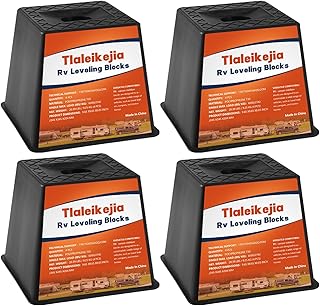
Best for: Campers facing uneven terrain where individual blocks can be stacked to achieve precise leveling. Each block supports up to 6000 lbs and is made from polypropylene for durability in various weather conditions.
Why selected: The stackable design enables customizable leveling on rough sites without needing a large, heavy lifting system. It’s practical for setups with limited ground clearance or when additional height is needed in steps.
Best for: Those who want a modular approach to leveling with simple stacking. Avoid if you need a full screw or hydraulic lifting mechanism instead of blocks only.
Caution: Stacking depth matters; adhere to recommended stacking limits to preserve stability and avoid damage to the blocks on soft soil.
LIBRA 9K lb HD 24″ Stabilizer Jacks (Set of 4)

Best for: Large trailers or SUVs that require high‑capacity stabilization with quick setup. These jacks are made from 11‑gauge steel and come with a 3/4″ hex magnetic socket for fast power‑drill operation, which speeds leveling on heavy rigs.
Why selected: High load capacity and complete hardware included help streamline installation and setup, especially for users with heavier campers who need reliable, steady support on sandy or uneven sites.
Best for: Users who prioritize a complete installation kit and fast power‑drill operation. Consider alternative if you need lighter components or lower overall weight for portability.
Caution: The heavy steel construction adds weight; ensure your transport setup can handle the added load and consider the time needed for manual handling during leveling.
Buying Guide: Key Factors For Pop Up Camper Leveling Jacks
- Purpose: Choose stabilizers for stabilization only or include lifting capability for level adjustments. If you rarely need to raise the trailer, stabilization‑only options may suffice.
- Weight Rating: Match the jack or block capacity to your camper’s weight. Exceeding capacity reduces effectiveness and safety.
- Height Range: Consider the ground height and how high you must lift to achieve level ground. Taller jacks provide more flexibility on uneven sites.
- Material: Steel offers strength and durability; aluminum reduces weight but may have lower corrosion resistance in some environments. Polypropylene blocks are lightweight and heat resistant but may require careful stacking on softer ground.
- Stability Features: Look for wide bases, anti-slip surfaces, and square bases to minimize shifting on soft soil or gravel.
- Ease of Use: Crank handles, hand tools, or power‑drill compatibility can affect setup time, especially when solo camping or after a long travel day.
- Installation and Hardware: Some sets include mounting hardware or required sockets. Ensure you have compatible tools for installation if adding a fixed system to the trailer.”,
Frequently Asked Questions
- What is the difference between stabilizer jacks and leveling blocks?
– Stabilizer jacks lift and stabilize the trailer to prevent movement; leveling blocks adjust the height under the tires or stabilizers to level the trailer on uneven ground. - Do I need power tools to use these jacks?
– Some models support a power drill for faster extension, while others rely on a hand crank. Check the product features to confirm. - Can I use aluminum jacks on rough terrain?
– Aluminum jacks are lighter and corrosion resistant but may not tolerate heavy loads as well as steel in extreme conditions. Use high‑capacity steel jacks for heavier trailers. - Are these jacks suitable for trailers with soft ground?
– Jacks with wider bases and stable contact surfaces perform better on soft soil, but additional ground protection like mats or blocks may be needed. - How many jacks should I install on a trailer?
– A 4‑pack is common for balanced stabilization across the frame, though some setups may use more depending on trailer length and weight distribution. - Is stacking blocks safe on uneven terrain?
– Yes, if you follow stacking limits and place blocks on solid ground or approved pads to prevent sinking or wobbling.