When you’re camping in a van, a compact, energy-efficient portable air conditioner can transform your comfort level. This guide focuses on compact, van-friendly units that deliver reliable cooling without draining your power or adding bulk. The top picks below are best for different needs: the Outohome 5200 BTU for strong cooling in tight spaces, BougeRV PC35 for app control and portability, BODEGA’s 6000 BTU for larger small spaces, FO-KOKO’s 5200 BTU for low power use, and Karinear’s 3300 BTU for ultra-compact setups. Use the quick comparison table to decide which best fits your van life.
| Product | Best For | Approximate Space | Power (W) | Key Benefit |
|---|---|---|---|---|
| Outohome 5200 BTU Outdoor/Indoor | Mid-sized vans and campers | Small to midsize rooms | < 400 | Strong cooling with quiet operation |
| BougeRV PC35 Portable Air Conditioner | App-controlled convenience | Small spaces | Low power | Long-range app control |
| BODEGACOOLER 6000 BTU | Small tents and tight cabins | 32-54 sq ft | Not specified | Real compressor cooling with multiple modes |
| FO-KOKO 5200 BTU | Balance of power and efficiency | Small rooms to tents | 400 | Dual-loop water cooling for faster chill |
| Karinear Portable 3300 BTU | Ultra-compact setups | Smaller tents and cabins | 436 | Quiet operation with 3 modes |
Outohome 5200 BTU Portable Tent Air Conditioner

Best for: van dwellers needing strong cooling in compact spaces. This unit uses a GMCC compressor delivering 5200 BTU and can lower ambient temperature by about 18°F within five minutes. Temperature is adjustable from 60°F to 88°F, and power usage stays under 400W per hour. It includes four modes—Cooling, Dehumidifying, Sleep, and Fan—with a remote control and a 24-hour timer. Quiet sleep mode operates at 46-50dB, making it suitable for overnight use. Consider its weight (about 31 lbs) if you need frequent repositioning inside a van.
BougeRV PC35 Portable Air Conditioner
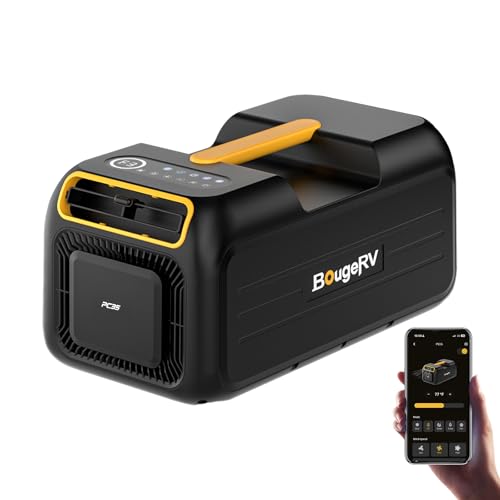
Best for: van campers who want smart control from a distance. The BougeRV PC35 cools up to about 64 square feet with 3500 BTU cooling power and can drop temperatures by roughly 10°C (18°F) in 15 minutes in strong mode. It features BougeRV App control within 33 feet, allowing climate adjustments without leaving your seat. Its ergonomic handle supports easy transport. A limitation to note: the app functionality relies on a stable connection and may require setup time for first use.
BODEGACOOLER Portable Tent Air Conditioner 6000 BTU

Best for: campers needing real compressor cooling in small tents or restricted spaces. This unit delivers 6000 BTU with a mention of cooling range appropriate for 32-54 sq ft. It offers five practical modes: Cooling, Dehumidifier, Sleep, Fan, and Max Cool/Forced Cooling. The compact enclosure (11.1 x 22.2 x 12.3 inches) helps placement near a tent opening or small shelter. Limitation: detailed electrical requirements and duty cycle vary by setup, so verify compatibility with your power source before use.
FO-KOKO 5200 BTU Portable Camping Air Conditioner

Best for: van setups requiring efficient cooling with lower power draw. This 5200 BTU unit uses a dual-loop water cooling approach, claiming faster heat dissipation and 3.6°F colder airflow than standard portable ACs. It cools up to about 130 square feet and operates at 60-88°F with 400W input. Its portable form and carrying handle support easy transport. A potential consideration is the need for compatible water supply or closed-loop cooling depending on the model variant.
Karinear Portable Air Conditioners For Camping

Best for: ultra-compact van setups or personal tent spaces. This 3300 BTU unit provides three cooling modes—Cool, Dehumidify, and Fan—and a compact 11.8 x 13.38 x 13.78 inch body weighing about 29 pounds. It operates quietly at under 50 decibels and supports standard 110V plug-in. Choose this if you need the smallest footprint and simple operation; however, its cooling power is lower than larger models, so it’s best for smaller spaces.
Buying Guide
Power source and energy use: Verify the unit’s wattage and your van’s electrical capacity. Look for models that stay under 400W per hour in cooling mode to preserve battery life when off-grid.
Cooling capacity vs. space: Choose BTU ratings appropriate for your van’s interior volume. For larger small vans, 5000–6000 BTU can feel noticeably cooler; for compact vans, 3300–3500 BTU may suffice.
Noise and comfort: Quieter sleep modes (below 50dB) improve rest. Consider whether the unit has a dedicated sleep or eco mode to minimize running noise.
Portability and setup: Handles, weights around 25–31 pounds, and compact dimensions improve maneuverability in tight van spaces. Consider whether you need a carry bag or easy-removal design for frequent repositioning.
Controls and connectivity: App control or remote control offers convenience. Confirm compatibility with your phone or preferred control method and ensure reliable range if you plan to operate from your seat.
Durability and use case: Real compressor cooling typically performs better than fan-only options in hot climates. If you regularly use in tents or outdoors, ensure the unit is designed for outdoor exposure or enclosed spaces as intended.
FAQ
- What size portable AC is best for a van? – A unit between 3300 and 5200 BTU typically fits most van interiors, balancing cooling power with space and power consumption.
- Can I run these on a standard 110V outlet in a parked van? – Yes, most models are designed for standard 110V wall outlets, but check the power draw to ensure it won’t overload your power source.
- Do portable camping ACs work well in tents? – Many models are designed for tents and small shelters, especially those labeled for tent or camping use, but ensure adequate ventilation and power access.
- Is app control worth it for van camping? – App control adds convenience for adjusting temperature and modes from inside the cabin or while parked outside, reducing the need to get up.
- Are these units loud? – Most models offer Sleep or Eco modes with low noise, typically under 50–50dB in quiet operation.
- What maintenance is required? – Regularly check water or condensate management as required by the model, clean filters if present, and store units in dry conditions when not in use.