Answer: For travelers who need reliable cooling in an RV, portable caravan air conditioning units offer flexible, denser climate control without permanent installation. The top picks below are best for different setups—from compact campers and vans to larger motorhomes and holiday caravans. This guide compares 5 options, highlighting who each model suits, practical limits, and how they fit into a mobile lifestyle.
| Product | Brand | BTU | Best For | Notes |
|---|---|---|---|---|
| Ivation 6,500 BTU Camper AC | Ivation | 6,500 | Small RVs, vans, and over-the-sill installs | Quiet, window-sill design; noise dampers reduce vibration |
| WUEZOE Portable AC with Remote | WUEZOE | 4,000 | Travelers needing no-install cooling | 3 mist levels, large 1000 ml tank |
| Line Blaster 8,500 BTU 3-in-1 | Line Blaster | 8,500 | Small apartments and RVs up to mid-size spaces | Quiet, 3-in-1: Cool/Dry/Fan |
| Generic Split Mini Portable AC | Generic | — | Renter-friendly wall-mounted option | No venting required; very quiet |
| Humuge Mini 4-in-1 | Humuge | — | Compact living areas, desks, dorms | 4-in-1: AC, humidifier, fan, light |
Ivation 6,500 BTU Camper AC
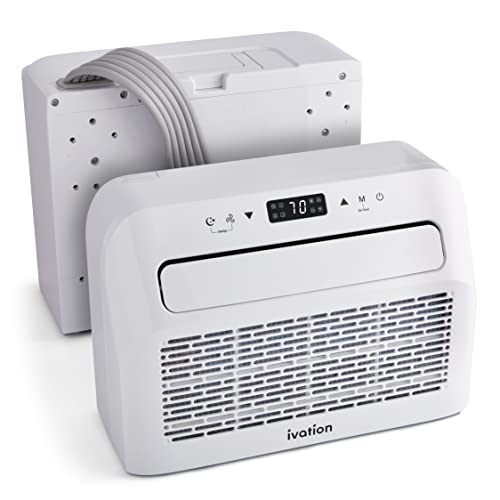
The Ivation unit is a compact, 6,500 BTU air conditioner designed for RVs, caravans, and similar confined spaces. It combines cooling, dehumidification, and ventilation in a single package, with a window-sill, “over the sill” installation that preserves the window view and natural light. This makes it best for smaller campers that need a quiet, stable climate without large interior modules.
Best for: small motorhomes, caravans, and camper vans that require minimal window disruption and reduced noise. The saddle-mounting setup minimizes sound propagation and vibration, offering a smoother sleeping and lounging environment.
Limitations: as a 6,500 BTU unit, it may be less effective in the hottest, humidity-heavy conditions or larger RVs. Consider backup or supplemental cooling for very warm regions.
WUEZOE Portable AC With Remote
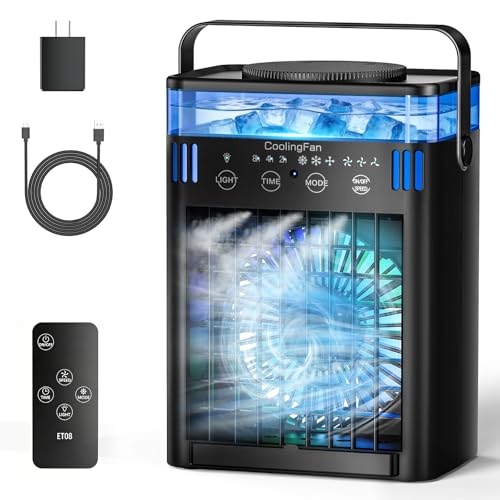
This portable 4-in-1 unit functions as an air conditioner, fan, humidifier, and night-light. It’s designed for immediate cooling with zero installation, which makes it ideal for travelers who need quick relief in hotel rooms, RV interiors, or tents when the weather shifts unexpectedly. It supports three mist levels and three fan speeds for flexible comfort.
Best for: travelers who want a completely portable, install-free cooling option with humidification and ambient lighting for small living spaces or bedside areas.
Limitation: cooling performance may be less powerful in very large spaces; best suited to smaller rooms or personal cooling in a caravan cabin.
Line Blaster 3-in-1 8500 BTU

The Line Blaster unit provides stronger cooling for small-to-medium spaces, with 8,500 BTU and a three-mode system (cool, dry, fan). It’s designed for bedrooms or compact living areas and includes a window kit for straightforward setup in apartments or RV cabins that accommodate a portable unit.
Best for: RVs or small homes needing a more powerful portable option that still fits in standard window or partial-vent configurations. Choose this if you want consistent cooling with humidity control in a modest area.
Caution: ensure the space has appropriate clearance for airflow and window mounting to avoid obstruction or heat buildup around the unit.
Generic Split Mini Portable AC

This no-vent, wall-mounted mini split is a ductless cooling option that doesn’t require window venting. It’s well-suited for spaces where window units aren’t feasible, including some RVs or small apartments. The setup emphasizes quiet operation and energy efficiency, making it suitable for renters or temporary setups.
Best for: spaces where traditional window air conditioners won’t fit or aren’t allowed, such as certain RV interiors or rental units in compact configurations.
Limitation: installation on a wall may require some wall access and mounting clearance; not ideal for completely mobile temporary setups where you frequently relocate.
Humuge Mini 4-in-1

The Humuge unit combines air conditioning, humidification, a personal fan, and ambient LED lighting. It is compact and particularly suitable for small bedrooms, desks, or dorm rooms, making it a versatile option for travelers who need a light footprint with multiple functions in one device.
Best for: compact living spaces like a small RV cabin, desk setup, or dorm-style room where space and versatility matter. It’s ideal for cooldowns and moisture control in tight quarters.
Limitation: its cooling capability is best for smaller areas; it may require supplementary cooling for larger RV interiors or peak heat conditions.
Buying Guide: How to Choose the Right Portable Caravan AC
What size space do you need to cool? BTU ranges from compact 4,000–6,500 BTU units to larger 8,500–14,000 BTU models. For small caravans or vans, aim for 4,000–6,500 BTU. For mid-size motorhomes, consider 8,000–10,000 BTU. Larger RVs may require 12,000 BTU or more.
Do you prefer install-free operation? If yes, prioritize models like the WUEZOE, Humuge, or other no-vent, portable units. If you don’t mind window mounting, a compact window-attach unit can offer stronger cooling and better efficiency.
How important is noise? Look for units with dampers, sleep mode, and low decibel ratings. Quiet operation is especially important for bedrooms and night-time use in RVs.
What extra features matter? Dehumidification reduces interior humidity; timers help manage energy use; remote controls increase convenience during travel; integrated lights or humidifiers may add value for certain setups.
What is your installation environment? Consider window availability, wall-mount feasibility, and how often you will move the unit. Some solutions are better for fixed-site caravans, while others excel in mobile campers.
FAQ
- What is a portable caravan air conditioner? A portable unit designed to cool, dehumidify, or ventilate small, mobile living spaces such as RVs and caravans, often with window-sill or wall-mount options.
- Do these units require professional installation? Most portable options do not. Some require window kits or wall mounting, but no permanent electrical or refrigerant work is needed.
- Which BTU size should I choose for a small RV? For very small RVs, 4,000–6,500 BTU is usually sufficient, depending on insulation and climate. In hotter climates, aim for the upper end of that range or a larger model if space allows.
- Can I use these units in tents or open caravans? Some compact units work well in semi-enclosed spaces, but large open areas may need more powerful or multiple units for even cooling.
- Is energy efficiency important for mobile use? Yes. Look for units with energy-saving modes, timers, and high CEER/SEER values to reduce power draw during extended trips.
- What maintenance is required? Regularly empty the water tank if the unit uses evaporative cooling, clean filters, and ensure vents are clear of dust for optimal airflow.