Answering the common buyer intent, these portable generators for travel trailers combine RV-ready outlets, quiet operation, and reliable runtime. The top picks below are best for different needs: the PowerSmart models suit campers who want higher surge power and long run time; the MaXpeedingrods and WEN units fit travelers needing lightweight, dual-fuel options; Champion offers a compact option with optional parallel fueling for extended power; and Jackery provides a compact, solar-ready power station for off-grid days. Use the overview table to compare core specs at a glance.
| Product | Best For | Key Benefit |
|---|---|---|
| PowerSmart 3600-Watt Inverter | RV owners needing high surge and clean power | Strong starting watts with stable sine wave |
| PowerSmart 3800-Watt Inverter | Quiet, larger RV setups | Very quiet at 59 dBA, portable for its wattage |
| MaXpeedingrods 3500-Watt | Travelers needing multiple outlets | Multiple outlets including RV 30A |
| Champion 4000-Watt RV Ready | Lightweight backup for camping | CO shield, parallel-ready |
| Jackery Explorer 300 | Off-grid camping and light travel | LiFePO4 battery, solar panel option |
PowerSmart 3600-Watt Portable Inverter Generator

Best suited for: RVs with higher starting power needs and sensitive electronics. This model provides 3600 starting watts and 3200 running watts from a 149cc OHV engine, enabling use of 15,000 BTU RV air conditioners, refrigerators, and tools with a stable 26.7A output. It uses advanced inverter technology to deliver a clean sine wave with less than 3% THD, protecting laptops, phones, and micro-electronics. Its 1.3-gallon tank supports up to around 8 hours at 25% load, reducing frequent refuels during overnight trips.
Why it’s selected: It balances strong surge power with clean power suitable for sensitive devices and moderate trailer air conditioning. Choose this if you need robust peak power and steady output for long camping sessions.
Caution: Fuel consumption may be higher at peak loads; plan refueling intervals accordingly.
PowerSmart 3800W Portable Inverter Generator

Best for: RV setups requiring higher continuous power with quiet operation. This generator delivers 3800 starting watts and 3200 running watts with a stated 59 dBA at 23 feet, making it notably quiet for parks with noise restrictions. It weighs about 52 lbs and is designed for easy carrying to tailgates, campsites, or remote cabins, providing clean sine-wave power for electronics and appliances alike.
Why it’s selected: The blend of substantial power, quiet operation, and portability makes it a versatile option for mid-sized RVs and longer trips.
Caution: The unit’s compact form means less visceral storage space; ensure you have a secure place for transport in tight RV storage bays.
MaXpeedingrods 3500 Watt Portable Inverter Generator
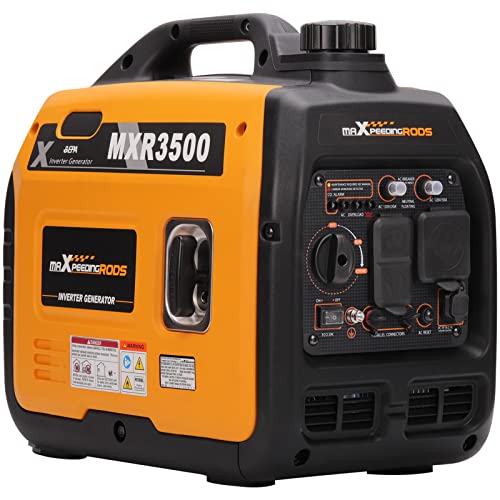
Best for: Travelers who want a compact yet capable power source with multiple outlets. This unit provides 3500 peak watts and 3000 running watts, and its lightweight design (around 47 lbs) makes it suitable for both travel and home backup power. It includes a 120V 30A RV outlet, two 120V 20A outlets, and two USB ports to cover common camping needs.
Why it’s selected: It offers adequate power for trailers and small appliances while maintaining portability. The Eco mode extends runtime by reducing engine speed during lighter loads.
Caution: The run time varies with load; high-demand devices may shorten runtime faster than expected.
Champion Power Equipment 4000-Watt RV Ready Inverter

Best for: Campers needing a lightweight, powerful backup with optional parallel capability. This inverter-generator weighs under 49 pounds and delivers 4000 starting watts and 3000 running watts, with up to 10 hours of runtime. It includes CO Shield auto shutoff and an option to connect another Champion inverter for doubled output via a parallel kit.
Why it’s selected: Its light weight and parallel-ready feature expand flexibility for larger setups or longer trips without sacrificing portability.
Caution: For best performance, use the proper parallel kit when doubling output and ensure both units are matched.
Jackery Portable Power Station Explorer 300

Best for: Off-grid campers and travelers who want a lightweight, solar-ready power option. The Explorer 300 offers 292Wh of LiFePO4 energy in a compact 7.5 lb package, with two AC outlets, USB-C PD, USB-A ports, and a 120W car port. It supports long-term use when paired with solar panels.
Why it’s selected: Its ultra-light design and durable battery chemistry provide reliable portable power for electronics, small appliances, and charging needs during extended trips.
Caution: It has lower continuous wattage; avoid running heavy appliances for extended periods without additional solar input or a larger unit.
Buying Guide
What should you look for when choosing a portable generator for a travel trailer?
- Power needs: Assess starting (surge) watts and running watts for your trailer’s essentials. RV air conditioners, refrigerators, and water pumps determine the required surge power.
- Noise level: If you camp in parks with sound restrictions, prioritize units with quiet operation measured in decibels at a practical distance.
- Fuel type and efficiency: Gasoline units are common, but dual-fuel options offer flexibility. Look for fuel efficiency and run-time at typical loads to minimize refueling.
- Portability vs. capacity: Heavier units may offer more power but require easier transport solutions. Consider a balance that fits your trailer’s storage and your travel style.
- Inverter quality: Inverter generators provide clean sine wave power. Ensure THD is low (preferably under 3%) to protect sensitive electronics.
- Outlets and compatibility: Confirm RV outlets (like 30A) and USB/AC ports match your devices. Some models offer parallel capability for scalable power.
- Runtime and maintenance: Check fuel tank capacity and expected runtime at a common load. Look for accessible maintenance features and included tools.
Practical buying considerations
Consider how often you power a full trailer vs. occasional camping. If you frequently power a high-demand air conditioner, prioritize units with higher surge watts and longer run times. If you want simple, portable power for weekend getaways, a lighter model with essential outlets may suffice. For off-grid adventures, add a solar-charging option like a compact power station to complement a gas generator.
FAQ
- What is the difference between starting watts and running watts?
Starting watts (surge) are the extra power needed to start motors. Running watts are the continuous power available for ongoing loads. - Are inverter generators safer for electronics?
Yes. Inverter generators deliver clean sine wave power with low THD, reducing voltage spikes that can harm electronics. - Can I parallel two generators for more power?
Some models support parallel operation with a kit to double output. Check compatibility before pairing units. - What maintenance helps extend generator life?
Regular oil changes, air filter cleaning, and fuel stabilizer use can extend life and reliability. - Is dual-fuel better for travel trailers?
Dual-fuel options add flexibility, especially in remote areas where one fuel type may be scarce. - Do I need a transfer switch for RV use?
A transfer switch provides safe, code-compliant power transfer between your generator and RV electrical system. It’s recommended for long-term setups.