When you’re camping, staying powered means staying connected, safe, and prepared. This guide highlights five practical portable solar chargers that suit different outdoor needs—from ultralight hikers to family campers who want to power multiple devices. Each option is evaluated for charging speed, capacity, durability, and versatility so you can pick the best fit for your trips.
Buyer snapshot table: Key features at a glance
| Product | Best For | Capacity | Ports | ||
|---|---|---|---|---|---|
| BLAVOR Solar Power Bank 10,000mAh | Lightweight hikers, solo travelers | 10,000mAh | USB-C, wireless | 20W fast charging, wireless option | Smaller capacity for long trips |
| SOARAISE Solar Charger Power Bank 48,000mAh | Group camping, multi-device charging | 48,000mAh | USB-A, USB-C, wireless, 4 built‑ins | 4 solar panels, built-in cables | Bulkier but high capacity |
| Durecopow Solar Charger Power Bank 20,000mAh | Versatile outdoor use, rugged conditions | 20,000mAh | 2 USB-C/USB-A, 3 ports total | Durable, multi-port charging | Didn’t specify solar panel efficiency |
| SOARAISE 48,000mAh Wireless (Blue) | Same high capacity with color option | 48,000mAh | USB-C, USB-A, wireless | Multiple cables included, strong capacity | Similar to other 48k models |
| BigBlue 28W Solar Panel Charger | Non-battery charging on-demand | N/A (panel) | Dual USB-C, USB-A | Efficient solar panel, portable | Panel cannot store electricity |
BLAVOR Solar Power Bank 10,000mAh
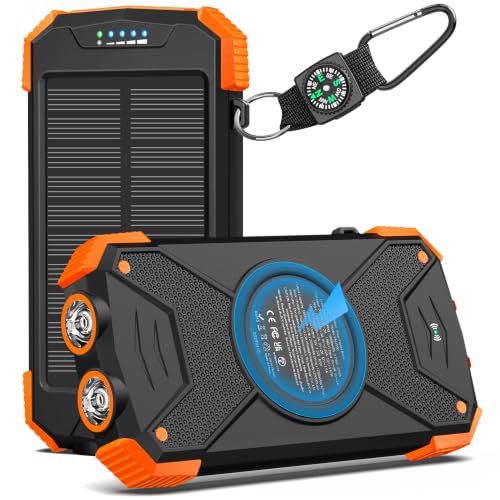
The BLAVOR model is designed for ultralight campers who want a compact charging solution. It features USB-C input/output with 20W fast charging and wireless charging capability, supporting up to three devices simultaneously. This makes it a fit for solo travelers who value quick top-ups for smartphones and small devices. The built-in battery uses a Lithium-cobalt chemistry that offers more cycling stability, contributing to longer-term reliability in outdoor use.
Best for: Solo hikers or minimal-kit campers who prioritize portability and fast mobile device top-ups. Why selected: its small size and decent 10,000mAh capacity pair with modern USB-C fast charging, making daily phone use practical on short trips.
Caution: The smaller capacity means more frequent recharges on longer expeditions, especially if you rely on power-hungry devices.
SOARAISE Solar Charger Power Bank 48,000mAh

This high-capacity unit is built for longer trips or groups. It bundles four solar panels and four built-in cables to support multiple devices without hunting for adapters. The 48,000mAh battery offers more charge cycles and the flexibility to supply several devices at once, including USB-C inputs/outputs and wireless charging. It’s well-suited for extended camping, remote hikes, or scenarios where you want to minimize power stops.
Best for: Campers who need to power multiple devices and extend battery life on longer journeys. Why selected: the four-panel setup accelerates solar charging and the built-in cables reduce clutter.
Caution: It’s larger and heavier, which may reduce backpack comfort for ultra-light travelers.
Durecopow Solar Charger Power Bank 20,000mAh

This charger emphasizes rugged durability with eco-friendly silicone rubber and ABS PC construction. It supports charging up to six devices simultaneously via three built-in cables plus one USB-A input, which is helpful for families or groups where diverse devices are present. The LED indicators and multiple ports support both everyday and emergency charging needs.
Best for: Outdoor enthusiasts who value rugged construction and multiple-device charging. Why selected: strong protection features and a multi-cable setup offer convenient versatility.
Caution: The solar charging efficiency isn’t specified; rely on direct sunlight for best results.
SOARAISE Solar Charger Power Bank 48,000mAh (Blue)
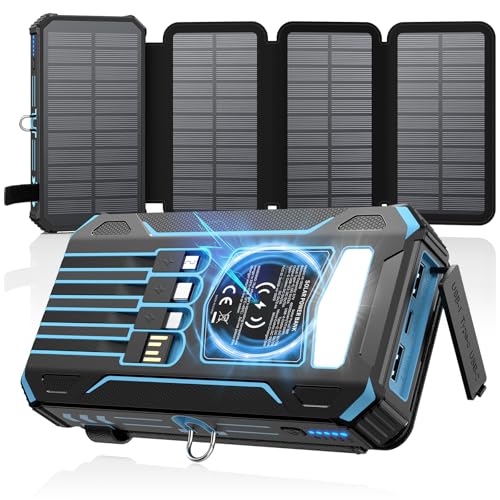
This blue variant mirrors the earlier high-capacity SOARAISE model with four panels and built-in cables. It’s positioned for campers who want a reliable power reserve and flexibility across devices. The included cables and wireless charging capability support a broad device mix—from smartphones to tablets to small cameras.
Best for: Campers who need a large power reserve with flexible multi-device charging. Why selected: consistent performance in a high-capacity package and multiple charging options.
Caution: The weight and size may be overkill for solo, minimalist trips.
BigBlue 28W Solar Panel Charger

This option is a solar panel rather than a built-in battery. It’s ideal for campers who already carry a portable power bank and want faster solar charging on the go. The 28W rating provides solid charge rates for phones, GPS devices, and small accessories when direct sun is available. Dual USB-C and USB-A ports allow simultaneous charging from the same panel.
Best for: Campers who already own power banks and want a robust solar panel to replenish devices. Why selected: high efficiency with practical, foldable portability.
Caution: The panel cannot store energy; you must connect it to a device or battery while in sun.
SOLUPUP Solar Panels 30W Foldable

The SOLUPUP panel focuses on efficiency and versatility with dual USB outputs (USB-A and USB-C) and an IPX5 waterproof rating. It’s designed to quickly identify devices and optimize charging speeds while protecting against overcurrent and short circuits. The integrated smart chip helps maximize solar energy use during outdoor adventures.
Best for: Outdoor users who want a reliable foldable solar panel with smart charging features. Why selected: efficient conversion and protective safeguards support reliable daytime charging.
Caution: It requires direct sunlight to operate at full capacity.
MARBERO Portable Power Station 88Wh

This compact power station targets campers who want an all-in-one solution for lighting, charging, and small appliances. It offers multiple outputs, including USB, USB-C, and AC, plus the option to pair with a dedicated solar panel. The built-in Battery Management System (BMS) supports safe distribution of power across devices.
Best for: Campers needing a portable, versatile power hub for small devices and emergency use. Why selected: a balanced mix of ports and a manageable form factor for backpacking trips.
Caution: The included solar panel compatibility is noted but not guaranteed for all charging scenarios.
Takki Solar Generator 120W Peak

The Takki unit integrates solar panels with a compact power station, offering up to 120W peak with two 110V AC outlets and multiple USB ports. It’s built for campers who need to power small appliances or work devices during outages or long trips. The foldable solar panel is included to support solar recharging in outdoor settings.
Best for: Campers who want a ready-to-go solar generator with AC outlets and ample charging options. Why selected: high peak power in a portable, backpack-friendly form.
Caution: High power usage may exhaust the battery quickly; monitor wattage when running appliances.
Buying Guide: Practical Considerations For Choosing A Portable Solar Charger
What capacity do you need?
Capacity, measured in mAh or Wh, determines how many charges you can get for a device. For a day trip with a single smartphone, 10,000mAh is often enough. For weekend trips or multiple devices, 20,000–48,000mAh offers more flexibility. If you camp for long periods or with a group, a higher-capacity option or a power station with multiple ports is preferable.
Should you choose a panel, a power bank, or both?
Portable solar panels are great when you already own power banks or USB-C batteries. Solar power banks combine storage with solar charging, reducing the need to carry multiple items. If you want a complete off-grid setup, consider a power station with solar panels designed to work together.
How many devices will you charge at once?
Look for models with multiple outputs (USB-C, USB-A, wireless charging) and built-in cables when traveling with diverse devices. If group charging matters, a unit with high-capacity battery and several ports is advantageous.
Durability and weather resistance
Outdoor use demands rugged materials, dust and water resistance, and protective housing for ports. Some devices emphasize drop resistance and silicone protection, which matter when you’re in remote terrain.
Charging speed and solar conditions
Solar efficiency depends on sunlight, panel quality, and battery type. Panels with multiple cells and smart charging can optimize energy collection. If you expect cloudy conditions, prioritize capacity and optional AC charging alongside solar inputs.
Portability vs. power trade-off
Smaller kits are lighter and easier to carry but offer less power. Larger power stations deliver more power and ports but add weight. Choose according to your typical trip length and how much you’re willing to carry.
Safety and certifications
Prefer models with protective features such as short-circuit protection, overcharge protection, and durable casings. Certifications like CE, FCC, and RoHS indicate compliance with safety standards.
Maintenance and longevity
Battery chemistry (lithium-ion vs. lithium polymer vs. lithium cobalt) can impact longevity and cycle life. Keep devices dry and clean, and store them partially charged to extend battery life when not in use for extended periods.
FAQ
- Can I charge my phone directly from a solar panel?
Yes, most portable solar panels provide USB outputs to charge phones directly, as long as there is adequate sunlight. - Is it better to buy a power bank with wireless charging?
Wireless charging adds convenience for compatible devices, but may add cost and reduce overall capacity slightly. - Do solar chargers work in overcast conditions?
They work, but charging speed is significantly reduced. Panels still convert diffuse light, but expect slower performance. - Should I unplug devices when solar charging?
Unplug devices when fully charged to preserve battery health and energy efficiency. - Are higher-capacity banks heavier?
Yes, larger capacities typically add weight. Balance capacity with how you plan to carry gear. - Do these devices include warranties?
Warranty details vary by product; check the manufacturer’s policy for coverage and duration.