Answering the common search for a rain fly tarp, this guide highlights top weather-ready tarps that protect hammocks and shelters. Best for ultralight hikers, backpackers, and campers seeking quick setup and reliable rain protection, these picks balance weight, durability, and versatility. Each option is evaluated for setup ease, material strength, and where it shines best. Whether you’re hammocking in light showers or bracing a downpour, these tarps help you stay dry and comfortable.
Overview of chosen products:
| Product | Best For | Key Strength |
|---|---|---|
| Pro Venture 12×9 Hex Rain Fly | Fast setup lovers | Hex design with six tie-downs |
| Wise Owl Outfitters Rain Fly | Budget backpackers | All-in-one setup, ultralight |
| Unigear 12×10 Rain Fly | All-weather hikers | Heavy-duty fabric and UV protection |
| Unigear 9.8ft Tarp (Brown) | Compact trips | Reinforced corners, strong waterproofing |
| JAICOM 10x10ft Tarp | Versatile shapes | Knotted webbing for multiple setups |
Pro Venture Rain Fly 12×9 Hex Shape

The Pro Venture rain fly uses PU 3000 Diamond Ripstop Nylon for weather resistance, tear- and puncture-resistance, and long-term durability. Its asymmetrical 12×9 hex design provides broad coverage, with six tie-down loops and six reinforced grommet points to maintain a streamlined shape. Includes six 3-meter guy lines and four aluminum stakes. Weighs roughly 1.8 lbs in a compact waterproof stuff sack, which makes it ideal for quick setups in unpredictable weather. Best for: campers who prioritize fast setup and robust weather protection in a lightweight package. Caution: setup is straightforward but may require extra guy lines in strong winds.
Wise Owl Outfitters Rain Fly

Wise Owl Outfitters provides a waterproof camping tarp with taped seams to block rain and shield hammocks during backcountry trips. The setup is an all-in-one package including six 10-foot guy lines, aluminum tent stakes, a stake pouch, and a waterproof carry bag. Weighing about 26 oz, it folds into a compact stuff sack, which suits ultralight backpackers or emergency tarp kits. Best for: hikers who want a ready-to-go shelter solution with essential accessories. Caution: heavier users or larger hammocks may benefit from a larger canopy in extreme weather.
Unigear Hexagon Rain Fly 12×10 ft

Unigear’s hex rain fly offers waterproof protection up to 3000 mm with PU coating and fully seam-sealed construction to prevent water ingress. The 210D polyester oxford fabric provides tear resistance, and an internal silver coating helps block UV rays. The tarp ships with six high-strength 7075-T6 aluminum ground nails and six wind ropes, plus copper rings, ensuring stable anchoring. Best for: campers who demand strong water resistance and UV protection with durable hardware. Caution: heavier fabric can add some weight compared to ultralight options.
Unigear 9.8ft Tarp for Camping
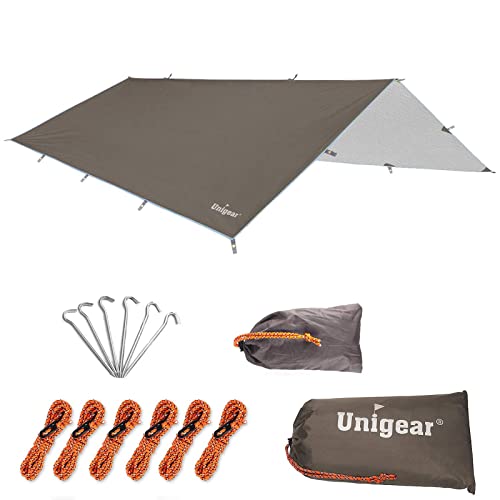
This Unigear tarp focuses on UV protection and durability with PU 3000mm waterproofing and reinforced corners. The 210D fabric resists tearing at eight fix points, using double reinforced stitches for added ruggedness. Aimed at hammock camping and ground shelters alike, its compact design makes it suitable for frequent move-and-camp trips. Best for: travelers needing reliable rain coverage with resilient construction. Caution: the 9.8 ft size may require multiple tie-downs in very windy conditions.
JAICOM 10x10ft Camping Tarp

JAICOM’s 10×10 tarp offers versatility with 11 sets of knotted webbing and 7 corner holes, enabling multiple shelter shapes. The 210T tear-resistant fabric with waterproof coating provides solid protection for rain and sun. It weighs around 2.1 lbs and is easily portable for camping, picnics, or as a tent or hammock shelter. Best for: campers who want flexible shelter configurations and a lightweight, compact package. Caution: more setup options may require a bit more time to arrange optimally in rugged terrain.
Buying Guide
What should you consider when choosing a rain fly tarp?
- Coverage and shape: Hex vs rectangle. Hex designs often offer good coverage with fewer anchor points, while rectangular tarps can be easier to pitch in constrained spaces.
- Material and waterproofing: Look for PU coatings with ratings around 2000–3000 mm for reliable rain protection. Ripstop or reinforced fabrics decrease tearing risk in windy conditions.
- Weight and packability: Backpackers prize lighter tarps that pack small. Heavier tarps may provide more durability and room.
- Hardware and anchors: Aluminum stakes and strong guy lines improve stability in gusty weather. Check for rust-resistant components.
- Setup versatility: Tarps with multiple tie-down points and webbing allow various shelter shapes—important for uneven terrain.
- Accessories: Included guylines, stakes, and carry bags add value; some sets come with stakes and pouches for quick deployment.
Frequently Asked Questions
- What size rain fly should I choose for a hammock?
– Consider 10×10 ft to 12×9 ft for standard hammocks; larger if you need more rain coverage or plan to sit underneath. - Are hexagonal tarps easier to set up than rectangular ones?
– Hex tarps often require fewer anchor points and can give good coverage with a simpler pitch, but rectangular tarps can be easier to adapt to flat ground. - Is UV protection important for a rain tarp?
– Yes, UV coatings help shield you from sun exposure when the tarp is used as shade, not just rain protection. - Can a rain fly double as a tent footprint?
– Some tarps are designed to function as tent footprints or ground covers; check the product description for specific compatibility. - Do I need extra stakes for windy conditions?
– In high winds, additional stakes and guy lines improve stability; ensure you have suitable anchors for the terrain. - How do I prevent leaks at seam areas?
– Choose tarps with full seam-sealing and reinforced corner stitching; ensure all seams are properly taped or sealed before use.