Direct answer: these five lifesaving ropes offer reliable buoyancy, robust hooks, and clear visibility for pool, beach, or boat rescues. They’re best for lifeguards, pool managers, boaters, and family-owned beach setups. Each option provides a strong throwing rope with a compatible snap hook and a proven 8mm to 10mm diameter, designed to stay afloat and resist corrosion. Below, find concise comparisons and reasons to choose each product, plus a practical buying guide to match your rescue needs.
| Product | Best For | Length / Diameter | Key Benefit |
|---|---|---|---|
| Acostop Water Floating Lifesaving Rope (49.2 ft, 8 mm) | Boat owners and home pools | 49.2 ft / 8 mm | Lightweight throw rope with corrosion-resistant snap hook |
| Shappy Floating Rope Life Ring Rope (15 m / 16.4 yds) | Public pools and outdoor facilities | 15 m / ~1/4 in | Strong nylon-like design with durable hooks |
| Acostop Water Floating Lifesaving Rope (49.2 ft, 8 mm, orange) | Lifeguards and home pools | 49.2 ft / 8 mm | Buoyant polypropylene rope with threaded stainless hook |
| CtopoGo Water Floating Lifesaving Rope (98.4 ft, 30 m) | Beaches, yachts, large pools | 98.4 ft / 8 mm | Very long throw rope with hand ring for easier retrieval |
| Taylor Made 374 Ring Buoy Holder with 60-Foot Heaving Line | Commercial life-saving setups | 60 ft | Corrosion-resistant aluminum ring buoy holder |
Acostop Water Floating Lifesaving Rope 49.2 Ft

Best for boat owners and pool environments requiring a compact, buoyant rescue line. The rope uses polypropylene for light weight and buoyancy, and includes a snap hook made of stainless steel to resist seawater corrosion. It’s 49.2 feet long with an 8 mm diameter, suitable for quick throws and secure connections. Caution: eight-millimeter diameter may limit reach in very wide rescue scenarios; assess your space before deployment.
Shappy Floating Rope Life Ring Rope (15 m)

Best for public pool areas and outdoor facilities needing a longer line with good visibility. The hollow polypropylene design aids splicing and durability, and the snap hook is galvanized with stainless steel components for corrosion resistance. The 15-meter length and roughly 1/4 inch diameter provide versatility for various rescue setups. Caution: ensure the rope is secured and knots are properly tied to prevent unthreading during vigorous use.
Acostop Water Floating Lifesaving Rope (49.2 ft, Orange)

Best for pool facilities and lifeguards who prefer high-visibility orange color. The rope features polypropylene construction for buoyancy and easy throwing, with a stainless steel snap hook designed to resist seawater corrosion. The 8 mm diameter remains manageable for rapid rescues. Caution: keep spare knots and checks on the rope to ensure the line remains secure under tension.
CtopoGo Water Floating Lifesaving Rope (98.4 ft)
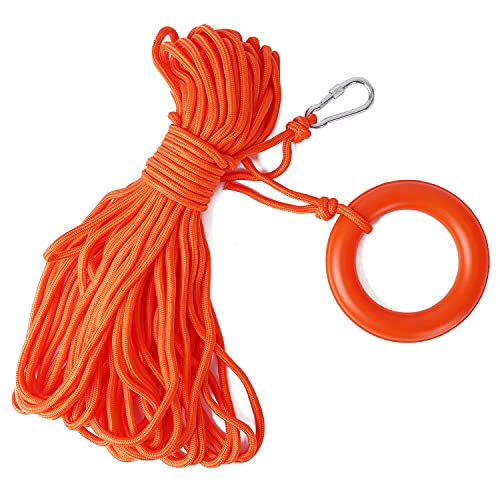
Best for long-range throws and large aquatic environments. This rope is notably long at 98.4 feet with an 8 mm diameter and includes a hand ring for easier retrieval after deployment. It’s portable and suitable for boats, beaches, and public pools. Caution: longer lines can be heavier to manage in windy conditions; practice proper handling and storage.
Taylor Made 374 Ring Buoy Holder with 60-Feet Line

Best for commercial life-saving setups requiring a complete ring buoy and line system. The anodized aluminum holder provides corrosion resistance, and the 60-foot white floating heaving line attaches readily to a ring buoy for rapid deployment. The rope float measures 5-1/4 inches long by 3 inches in diameter, aiding visibility. Caution: ensure compatibility with your buoy and storage space before installation.
Buying Guide
What length do you need? Short lines (25–50 ft) are ideal for pool decks and small boats. Medium lengths (50–80 ft) suit mid-range docks and smaller yachts. Long lines (80–100 ft) work for large pools and open-water scenarios.
What diameter matters? 8 mm is common and easy to handle; 10 mm provides extra strength but can be heavier to throw. Consider your typical rescuer’s reach and the target distance.
Material and durability: polypropylene provides buoyancy and light weight; stainless steel hooks resist corrosion better than galvanized options. For saltwater use, prioritize stainless hardware and robust stitching.
Visibility and color: high-visibility colors (orange, blue-white) help locate the rope quickly. In busy water areas, bright colors reduce retrieval time during emergencies.
Hardware and safety: look for threaded or locking hooks to prevent accidental loosening. Ensure the rope has secure end fittings and that knots hold well under load.
Storage and portability: consider whether the rope is easy to coil and transport. For boats and lifeguard cars, lighter lines with carrying loops or hand rings improve readiness.
What to consider for your use case
- Pool use: choose mid-length lines (50–60 ft) with durable, corrosion-resistant hooks.
- Small boat use: prioritize 49–60 ft lines with strong hooks and secure knot options.
- Public beaches and docks: longer lines (80–100 ft) can extend rescue reach but require better handling skills.
Safety reminders
- Always practice with the rope before an emergency to ensure proper throwing technique and knot security.
- Inspect the rope and hooks regularly for wear, rust, or fraying and replace as needed.
- Store in a dry, accessible location to reduce material degradation from sun and salt exposure.
FAQ
- What length is best for a home pool rescue rope?
- Why choose stainless steel hooks over galvanized hooks?
- Should I prefer solid color or two-tone ropes?
- Can these ropes be reused after a rescue?
- Is there a recommended storage method?
About 49–60 feet (15–18 meters) is typically suitable for most home pools, offering a safe reach without excessive weight.
Stainless steel resists seawater corrosion better, reducing risk of rust and failure in marine environments.
Two-tone (like blue-white) or bright orange improves visibility in busy water areas, helping rescuers locate the line quickly.
Yes, but inspect for fraying, knots loosening, or hook deformation. Replace if any integrity concerns exist.
Coil the rope neatly and store in a dry, shaded place away from direct sun to extend life and maintain buoyancy.