Summary: This guide reviews five top RV air conditioner units with heat pumps, focusing on efficiency, noise levels, installation ease, and suitability for different RV setups. Ideal buyers include off-grid travelers, space-conscious campers, and those seeking quiet, year-round climate control. The table below compares key features to help you pick quickly.
| Product | BTU (Cooling/Heating) | Best For | Notes |
|---|---|---|---|
| FOGATTI RV AC Unit 16K BTU | 16,000 / heat pump | Comfort on the go; quiet operator | Ultra-low 43 dB; easy non-ducted install |
| RecPro RV Air Conditioner 15K Non-Ducted | 15,000 / heat pump | Off-grid or solar setups | Low amp draw; durable roof design |
| TOSOT 16,000 BTU RV A/C | 16,000 / heat pump | All-season RVs; shoulder-season comfort | WiFi remote; 43 dB |
| RecPro RV Air Conditioner 15K Ducted | 15,000 / heat pump | Better air distribution across vents | Ducted option; low noise |
| TURBRO Inverter 13.5K BTU RV A/C | 13,500 / heat pump | Compact RVs; high efficiency | Inverter system; slim profile |
FOGATTI RV AC Unit 16K BTU With Heat Pump

The FOGATTI 16K BTU model combines cooling and heating with a dual-motor, triple-fan system delivering about 418 CFM. With an EER of 11.8, it emphasizes high efficiency and lower power draw. The unit operates at a quiet 43 dB, making it suitable for travelers who want restful downtime on the road. It uses a non-ducted rooftop design that fits a 14.25″ x 14.25″ cut-out and requires minimal modification for installation. Best for RVs needing a compact, low-noise climate solution without a ducted system. A potential limitation is that it is not designed for ducted RV configurations.
- Best for: Small to mid-sized RVs where quiet operation is a priority.
- Better for: Quick installation with standard rooftop openings.
- Caution: Non-ducted fit may limit integration with ducted RVs.
RecPro RV Air Conditioner 15K Non-Ducted

This RecPro 15K unit focuses on low amp draw and off-grid readiness. Its UV-resistant, durable construction suits long road use, while the whisper-quiet operation at 55.4 dB reduces interior noise compared to traditional RV ACs. It’s a solid pick for travelers who need energy efficiency and a quiet night. It’s best used on RVs where a non-ducted installation is preferred or required.
- Best for: Off-grid setups with solar or generators.
- Better for: RVs prioritizing minimal energy use and quiet operation.
- Caution: Non-ducted design may limit distribution in some layouts.
TOSOT 16000 BTU RV A/C With Heat Pump

The TOSOT 16,000 BTU model provides year-round comfort with 16,000 BTU cooling and a 12,500 BTU heat pump. It supports temperatures from 23°F to 115°F, enabling operation in extreme climates. The unit runs quietly at about 43 dB, suitable for light sleepers. This option is best for RVs that require reliable performance in shoulder seasons and should work well in a variety of RV types, including trailers and Class B/C models. A limitation could be the need for a compatible control setup to fully leverage WiFi and remote features.
- Best for: RVs needing strong cooling and effective heating in shoulder seasons.
- Better for: Quiet operation during night use.
- Caution: Ensure compatibility with home WiFi control integration.
RecPro RV Air Conditioner 15K Ducted
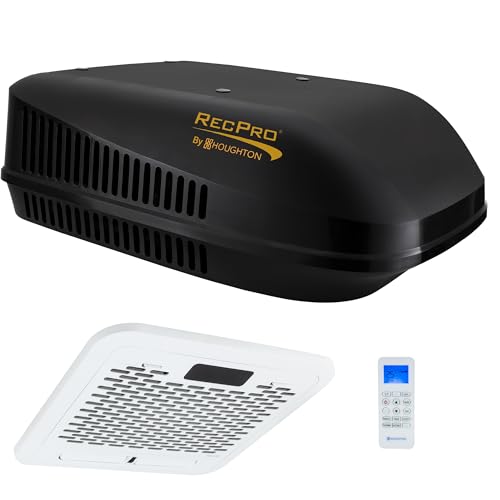
This 15K ducted RecPro model emphasizes flexible air distribution through multiple vents via ducting. It offers a low-amp draw suitable for off-grid setups and provides quiet operation, similar to other RecPro units. It’s a strong choice for RVs with installed ductwork or for those planning upgrades to a ducted cooling system. One limitation is that the ducted configuration requires appropriate roof space and venting arrangements.
- Best for: RVs with pre-existing ductwork or plans to install ducted air distribution.
- Better for: Even airflow across several rooms or zones in larger RVs.
- Caution: Ducted installation adds complexity and may require professional help.
TURBRO Inverter 13.5K BTU RV A/C

The TURBRO inverter-equipped unit delivers 13,500 BTU cooling with heat pump capability in a slim, low-profile rooftop package. The inverter system improves efficiency and reduces idle energy use, with a thickness around 10 inches to support a cleaner roof line and better fuel efficiency. It includes WiFi and remote control for convenient operation. This option is best for smaller RVs that still want year-round climate control with a compact footprint. A limitation is that it provides less cooling capacity than 15K–16K models, which may matter on hotter days.
- Best for: Compact or lighter RVs where roof space is limited.
- Better for: Energy-conscious travelers who value inverter efficiency.
- Caution: Lower cooling capacity than larger units; plan for hot days accordingly.
Buying Guide
What should I consider when choosing an RV AC with a heat pump?
Key factors include cooling/heating BTU required by your RV size, climate, and insulation level. A higher BTU is beneficial in hot climates, while heat pump efficiency matters in shoulder seasons. Consider whether you need a ducted or non-ducted system based on your roof layout and air distribution goals.
Non-ducted vs. ducted: Which is right?
Non-ducted units are easier to install and ideal for smaller RVs or when roof space is limited. Ducted systems provide even cooling throughout larger spaces but require existing or planned ductwork and can be more complex to install.
Noise and efficiency
Look for units rated around 40–45 dB for quiet operation. Inverter-driven systems typically offer better efficiency and smoother performance, especially in fluctuating ambient temperatures.
Power compatibility
Check your electrical system’s capacity and fuel source. Off-grid setups benefit from low amp-draw models, solar readiness, and compatibility with portable generators.
Smart features and control
WiFi and remote control enable convenient operation from inside the RV or remotely. Ensure the control system is compatible with your devices and has robust connectivity.
Installation considerations
Non-ducted units fit standard 14 1/4 x 14 1/4 inch openings and generally require fewer modifications. Ducted systems may demand more planning for duct routing and ceiling vent alignment.
Should you choose a model with a heat pump?
Heat pumps provide electric heating, which is favorable for mild shoulder seasons. If you camp in sub-freezing environments regularly, you may still need a supplementary heating source like a furnace or catalytic heater.
FAQ
- What is the typical noise level for RV roof air conditioners?
Most modern units operate in the 40–55 dB range, with premium models around 40–43 dB for quieter nights.
- Do I need a heat pump for my RV, or is cooling enough?
If you experience cool shoulder seasons, a heat pump adds electric heating and can reduce the need for propane or other heating methods.
- Can I install a ducted RV AC in a non-ducted RV?
Non-ducted units are designed for non-ducted openings. Ducted systems require appropriate roof openings and ductwork; retrofitting may be complex.
- Which model is best for off-grid camping?
Units with low amp draw and efficient heat pumps are ideal for off-grid setups, particularly when paired with solar or generators.
- Will a 16K BTU unit cool a small RV effectively?
Yes, for RVs in the 16–24 ft range, a 16K BTU unit provides strong cooling, often with efficient heat pump operation for shoulder seasons.