Answering the question “which generator is best for RV camping?” this guide highlights five practical options that balance portability, fuel type, and runtime. These models suit different buyers: weekend RV travelers needing quiet power, emergency backup planners, and campers who prioritize lightweight, easy-start units. Below is a quick summary table of the selected products to help you compare at a glance.
| Product | Fuel Type | Key Benefit | Best For |
|---|---|---|---|
| Oxseryn Power Equipment 4400 Watts Inverter Generator | Gas | Open-frame design, RV-ready, ECO mode | RVers who want long runtime and multiple outputs |
| PowerSmart 3800 Watt Dual Fuel Inverter Generator | Gas/Propane | Dual fuel flexibility, long runtime | Those who value fuel options and quiet operation |
| WEN 4800-Watt Dual Fuel RV-Ready | Gas/Propane | Quiet, CO watchdog, clean power | Campers prioritizing safety features |
| EnginStar Solar Generator, 300W | Solar/Lithium Battery | Portable, silent backup power | Minimal-noise camping and blackout prep |
| AIVOLT 4300W Inverter Generator | Gas | Quiet operation, compact design | Budget-friendly, compact RV use |
Oxseryn Power Equipment 4400 Watts Inverter Generator

The Oxseryn model offers 4400 peak watts and 3400 running watts, suitable for motor home use and emergency home backup. It features 2x120V AC ports, 1x12V DC, and an RV outlet, with ECO mode to extend runtime. The 2-gallon tank provides up to 14 hours at 25% load, making it a practical choice for longer trips. Best for RV campers who need multiple outlets and an economical run time between fills.
Who this is best for: RV travelers who want an all-in-one power source with RV-ready outlets and a straightforward fuel gauge. Why chosen: the multi-output design supports typical RV appliances while ECO mode helps conserve fuel. Caution: 2-gallon tank may require frequent refueling on longer journeys, especially at higher loads.
PowerSmart 3800 Watt Dual Fuel Inverter Generator
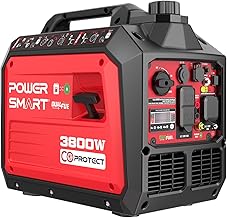
The PowerSmart unit delivers 3800 starting watts and 3300 running watts on gasoline and 3500 starting watts with 3100 running watts on propane. It runs 8 hours at 25% load on a 1.3-gallon tank and up to 24 hours on a 20-lb propane tank, especially when Eco mode is engaged. This makes it versatile for campers who appreciate fuel flexibility and extended runtimes. Best for: weekend campers who want to switch between gas and propane to match fuel availability. Caution: lower running watts on propane may affect high-load appliances.
WEN Quiet 4800-Watt Dual Fuel RV-Ready

The WEN DF480iX operates on gasoline or propane, delivering 4800 surge watts and 4000 running watts on gasoline, and 4320 surge and 4000 running watts on propane. It is noted for quiet operation and clean power suitable for sensitive electronics. Best for: RV users who need dependable power with CO monitoring features. Caution: dual-fuel capability can add complexity and weight, which matters for portability.
EnginStar Solar Generator, 300W

The EnginStar Solar Generator provides a compact 300W with a 296Wh lithium battery, ideal for silent camping and during outages. It includes two 110V pure sine wave outlets and is completely quiet, with no emissions. Best for: campers prioritizing silent power and portability. Caution: limited output means it cannot run high-wattage appliances for long periods.
AIVOLT 4300W Inverter Generator

The AIVOLT provides 4300W inverter power, aimed at steady RV use with quiet operation. It is designed for camping where compact size and reliability matter. Best for: cost-conscious campers who still want good power output. Caution: wattage is lower than some larger units, which may limit high-demand appliances for long periods.
Buying Guide
- Power needs: Estimate the starting and running watts of your RV appliances. Choose a generator with a comfortable margin over your peak needs to prevent overloading.
- Fuel options: Dual-fuel models offer flexibility when gas or propane is more available. Consider propane availability and running cost in your area.
- Noise levels: Inverter generators tend to be quieter and produce clean power. If you camp near others, prioritize low dBA ratings and ECO modes.
- Runtime and tank size: Match tank capacity to your typical trip length. Longer runtimes reduce refueling stops, especially away from services.
- Portability: Weigh and size matter for RV storage and carrying. Look for compact footprints and ergonomic handles if you move the unit often.
- Safety features: CO watchdog, automatic shutoff, and grounded outlets reduce risk near living areas. Consider models with integrated safety shutoffs.
- Outlet options: Ensure available outlets fit your RV cords and devices. RV-ready outlets are a plus for direct RV connection.
Frequently Asked Questions
- Do I need an inverter generator for RV use? Yes. Inverter generators deliver stable power suitable for sensitive electronics and generally run more quietly.
- What is the difference between surge and running watts? Surge watts cover peak startup demand, while running watts are continuous output.
- Is dual-fuel better for RV camping? Dual-fuel systems offer flexibility to use gas or propane depending on availability and cost.
- How loud is a typical RV generator? Inverter models typically produce lower noise, often suitable for quiet camping areas.
- Can I run full RV air conditioning on these models? Large air conditioners may require higher-wattage units; check the combined running watts against your A/C and other loads.
- How should I maintain a generator on a camping trip? Regularly check fuel and oil, run the unit in Eco mode to save fuel, and store it safely away from living areas when in use.