Answering the need for on-demand hot water in RV living, these systems provide instant heat, minimal wait times, and compact installation suited for mobile lifestyles. They are best for RV owners who want reliable hot showers, quick dishwashing, and flexible placement in tight RV spaces. This guide focuses on five top options, highlighting who each is best for and why it stands out, along with practical caveats to consider before buying.
| Product | Best For | Key Benefit |
|---|---|---|
| APUS RV Tankless Water Heater | Active RV families needing fast, on-demand hot water | High output and high-altitude readiness |
| ORBEK RV Tankless Water Heater | Large RV groups and frequent showers | Staged combustion for energy efficiency at altitude |
| Xenjum RV Tankless Water Heater | Full-time RVers and off-grid travelers | Dual outlets with remote control for precise temp |
| CAMPLUX AY132P43 Portable Kit | Off-grid camping and portable shower needs | Complete kit with 12V pump for remote water sources |
| InSinkErator H-HOT150SN-SS | Kitchen-focused hot water on demand | Stainless steel tank, near-boiling water on demand |
APUS RV Tankless Water Heater

The APUS model delivers instant hot water with 68,000 BTU and 3.9 GPM, designed for on-demand use in RVs. It is compact enough to fit in standard RV spaces and supports 12V DC operation with common NPT fittings. This unit is best for RV families seeking reliable, rapid hot water during showers, kitchen tasks, and cleaning without waiting for a tank to heat. A caution: high BTU output requires proper ventilation and compliant installation with propane systems.
Who it’s best for: RV families and frequent campers who want quick hot water and compatibility with standard RV layouts.
ORBEK RV Tankless Water Heater
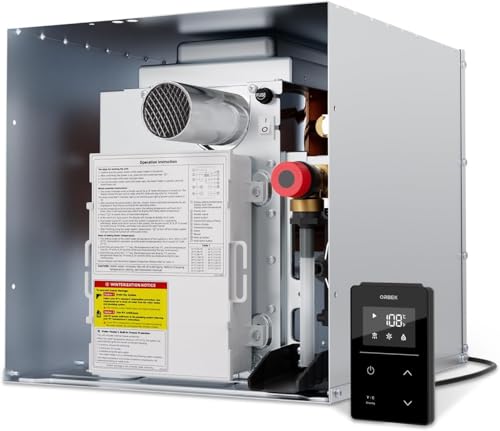
Orbek offers 60,000 BTU of heat with a focus on energy efficiency, using staged combustion to minimize propane use and maintain stable temperatures. It includes a remote control and is CSA certified, with compatibility across RV models. It’s ideal for busy families that want dependable hot water without frequent re-heating, even at higher elevations. A potential limitation: installation requires adequate space and proper venting for propane systems.
Who it’s best for: RV families and campers who value energy efficiency, altitude adaptation, and remote temperature control.
Xenjum RV Tankless Water Heater

Xenjum delivers up to 65,000 BTU and 3.9 GPM with dual outlets for interior and exterior use, plus a remote control for temperature management. Its design targets RVs that require flexible hot water delivery across multiple faucets or outdoor showers, while maintaining high-altitude reliability. A caution: ensure proper clearances for dual-output plumbing and exterior connections to prevent heat loss or leaks.
Who it’s best for: Full-time RVers or travelers needing hot water at multiple points in the vehicle and outdoors.
NVRZQWD Tankless Water Heater (Electric)

This electric 110V unit provides instant on-demand hot water with a compact, wall-mounted design. It’s suitable for RV cabins where electrical supply is readily available and a compact solution is preferred. It’s best for travelers who want a space-saving option that does not rely on propane, but may be limited by electrical capacity and flow rate at higher simultaneous demands. A caveat: 0.3–0.5 GPM at higher temps may require careful flow management to avoid temperature drop.
Camplux AY132P43 Portable Kit

Camplux provides a complete off-grid shower kit with a 12V pump and long power cables, designed to pull water from lakes, buckets, or RV tanks. It’s ideal for off-grid camping and remote campsites where pressurized water isn’t available. It is best for campers seeking a self-contained hot-water solution without relying on campground hookups. Caution: performance depends on water source proximity and pump capacity; use within recommended hose lengths to maintain flow.
Buying Guide
What should I consider before choosing an RV instant hot water system?
Fuel type: Propane units deliver independence from electrical supply but require ventilation and proper installation. Electric models avoid propane but rely on available power. Consider your typical camping setup and electrical capacity.
Flow rate and BTU: Higher GPM and BTU mean faster hot water but may increase fuel consumption or power needs. Match the expected number of simultaneous hot-water tasks (showers, dishes) with the unit’s capabilities.
Installation space: RVs have limited space. Look for compact dimensions and whether the unit can replace existing heaters or fit into common RV layouts.
Altitude performance: If you travel to high elevations, select models advertised as high-altitude ready, with efficient combustion or insulation to prevent temperature drops.
Controls and accessibility: Remote controls or external outlets offer convenience. Ensure compatibility with your RV’s electrical system and plumbing fittings.
Should I choose a tankless or a tank-based RV water heater?
Tankless systems heat water on demand and save space, avoiding standby heat loss. Tank-based systems provide a buffer of hot water, which can be beneficial for longer showers or if you have limited propane or power available. The choice depends on your usage patterns, space, and energy sources.
What are common installation caveats?
Proper venting is essential for propane units to prevent gas buildup. Ensure all connections use standard fittings and that the installation complies with local codes. For electric models, verify max amperage and wiring conditions to avoid tripping breakers or overheating.
Which option is best for budget-conscious buyers?
Look for compact electric or basic propane models with dependable performance. Portable kits, like the CAMPLUX system, can be cost-effective for off-grid trips, but verify pump and hose quality to prevent leaks and ensure reliable water delivery.
How do I maintain these systems?
Regularly inspect propane connections, seals, and venting for propane units. For electric systems, check wiring, fuses, and switches. Drain and inspect tanks or heat exchangers per manufacturer guidance to prevent mineral buildup and ensure consistent performance.
FAQ
- Q: Do RV instant hot water heaters work at high altitudes?
- A: Many models advertise altitude readiness; check the product specs for tested operating altitude limits and any required adjustments.
- Q: Can I install these myself in an older RV?
- A: Some models are designed for easy installation, but propane and electrical systems may require a licensed professional for safety and code compliance.
- Q: Is 3.9 GPM enough for a full shower?
- A: 3.9 GPM is generally sufficient for a standard shower, but actual experience depends on water pressure, temperature settings, and faucet design.
- Q: Do these systems require a separate water tank?
- A: Tankless options do not require a traditional tank, while some electric or hybrid units may integrate a small reservoir or tank with specific models.