Answer: If you want a quick, secure setup for outdoor sleep, choose a self-inflating pad with built-in pump and solid insulation. This guide highlights five pads that balance comfort, weight, and ease of use for car camping, backpacking, and backpacker-friendly trips. Best for mixed terrains, side sleepers, and campers who want faster setup and reliable warmth.
Summary of chosen products
| Product | Best For | Key Benefit | Approx. Loft |
|---|---|---|---|
| OGERY Self-Inflating Sleeping Pad with Built-in Foot Pump | All-around campers; car-tent setups | 3″ memory foam with built-in foot pump | 3 inches |
| FUN PAC Camping Sleeping Pad | Ultralight hikers; backpackers | Ultralight design with built-in pillow and 30–60s inflate | ~3–3.2 inches |
| Therm-a-Rest Basecamp Self-Inflating Foam Pad | All-season campers seeking proven insulation | Reliable 6 R-value insulation | Standard foam thickness |
| Elegear CumbreX Self Inflating Sleeping Pad | Value-conscious sleepers seeking high-density foam | Hi-Tech 26D memory foam for support | ~3.15 inches |
| Coleman Self-Inflating Sleeping Pad with Pillow | Casual campers; quick setup | No air pump required; included pillow | Moderate thickness |
OGERY Self-Inflating Sleeping Pad With Foot Pump

The OGERY pad integrates 3″ memory foam with a self-inflating design and a built-in foot pump. The foam core expands to provide even support across sleeping positions, while the foot pump allows on-demand firmness adjustments. Best for car campers or tents where quick setup matters and side sleepers benefit from pressure relief in shoulders and hips. A non-slip base helps keep the pad stable on tent floors or vehicle interiors. Caution: heavier users should verify weight limits and ensure the mat remains flat during setup to avoid gaps.
FUN PAC Camping Sleeping Pad With Pillow

The FUN PAC pad emphasizes ultralight design with an integrated pillow and 30–60 second inflation via built-in pump. It’s ideal for backpackers prioritizing pack weight and compact size, yet still provides up to 78″ length and 27″ width with ample thickness for comfort. Best for solo hikers who need a quick, no-fuss setup. Limitation: may feel firmer for users who prefer plusher surfaces when fully inflated.
Therm-a-Rest Basecamp Self-Inflating Pad

The Basecamp is a rugged option offering self-inflating convenience with a WingLock valve for rapid inflation and deflation. Its 6 R-value insulation supports use in varied seasons, including cooler nights. Best for campers who want a dependable, year-round sleeping surface and don’t mind a slightly higher packed size. Limitation: bulkier than some ultralight models, which may affect packability for minimalist trips.
Elegear CumbreX Self Inflating Sleeping Pad

Elegear combines Hi-Tech 26D memory foam with quick self-inflation, delivering substantial support and pressure relief. The pad measures about 77″ x 27″ x 3.15″ when inflated and holds up to 800 lbs, with a note that initial inflation may take longer due to vacuum packing. Best for campers who want hotel-like comfort outdoors and value a thick, supportive surface. Limitation: first inflation may take longer out of the box, especially when vacuum packed.
Coleman Self-Inflating Sleeping Pad With Pillow
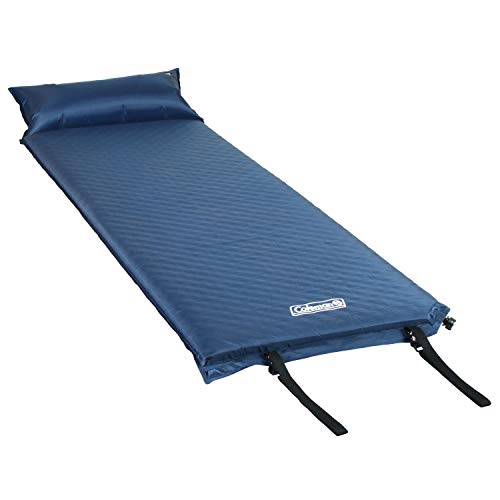
Coleman’s pad emphasizes a straightforward setup with no external air pump required and includes a built-in pillow for head support. It suits casual campers and those who value a simple, quick setup. Best for beginners or family trips where ease of use is a priority. Caution: may offer less insulation thickness compared to premium foam-filled designs in very cold conditions.
Buying Guide: Key Purchase Considerations
What thickness do you need? Higher thickness typically means more comfort and better insulation, but increases weight and packed size. For car camping, a thicker pad (3″ to 3.5″) often provides better pressure relief. For backpacking, consider lighter models with thin foam layers but adequate R-value.
Is self-inflation enough, or do you need a pump? Pads with built-in pumps simplify setup and reduce moisture exposure to air valves. If you repeatedly deflate and repack, look for robust valves and durable seams to minimize leaks.
What insulation level suits your environment? R-value indicates warmth. A 4+ R-value is advantageous for cold nights, while 2–3 may suffice in milder conditions. In ultra-cold damp environments, a pad with 4–6 R-value plus a compatible sleeping bag is recommended.
How important is weight and packability? Ultralight designs are ideal for backpackers, while heavier, thicker pads fit best with vehicle-based camping. Check packed size and weight to ensure it fits your backpack or car storage.
Durability and care. Look for abrasion-resistant fabrics and strong seams. Removable, washable covers offer hygiene benefits. Consider warranties or guarantees when selecting thicker foam models.
Quick comparison by scenario
- Car camping or full setup: OGERY Self-Inflating with Foot Pump or OGERY Upgraded version for thicker foam and high weight support.
- Backpacking with minimal weight: FUN PAC or Clostnature light variants, prioritizing compactness.
- All-season use with proven insulation: Therm-a-Rest Basecamp or Gear Doctors Oxylus for higher R-values.
FAQ
- What is a self-inflating sleeping pad? A pad that uses a foam core to draw in air and partially inflate itself, often with a valve to adjust firmness.
- Do these pads require an air pump? Some have built-in foot pumps or inflators; others inflate manually or with external pumps.
- Which pad is best for side sleepers? Pads with higher foam density and 3″ thickness generally offer better shoulder and hip pressure relief.
- Can these pads hold heavy sleepers? Many models support up to 800 lbs, but always check the manufacturer’s weight limit for safety.
- Are these pads good for cold weather? Pads with higher R-value insulation perform better in cold nights; pair with a warm sleeping bag for best results.
- How long do these pads last? Quality foam and durable fabrics extend lifespan, but performance can vary with use and care; follow care guidance from each product.