When choosing a compact, reliable hot water solution for an RV, trailer, or small kitchen, look for compact tank or tankless designs that fit your space and electrical setup. This guide highlights five compact options that balance fast heating, energy efficiency, and safe operation for travelers and tiny-home enthusiasts. The top picks are best for: frequent RV travelers seeking instant hot water; small-space homes needing under-sink or wall-mounted units; and folks who want reliable performance without heavy installations.
| Product | Type | Best For | Key Benefit |
|---|---|---|---|
| BISELONG 2.5 Gallon Under Sink | Tank | RVs, food trucks, boats | Fast heat-up, compact square design |
| Orbek RV Tankless Water Heater | Tankless | Full-time RV families | 60,000 BTU, remote control |
| NOVIEEX RV Water Heater | Tankless | Travel trailers, campers | 60k BTU, anti-freeze protection |
| Xenjum RV Tankless Water Heater | Tankless | Off-grid or high-demand RVs | 65k BTU, dual outlets |
| Feelrogast Electric Tank Water Heater | Tank | Under-sink setups, small kitchens | 8-gallon capacity, durable stainless tank |
BISELONG 2.5 Gallon Under Sink Tank Heater
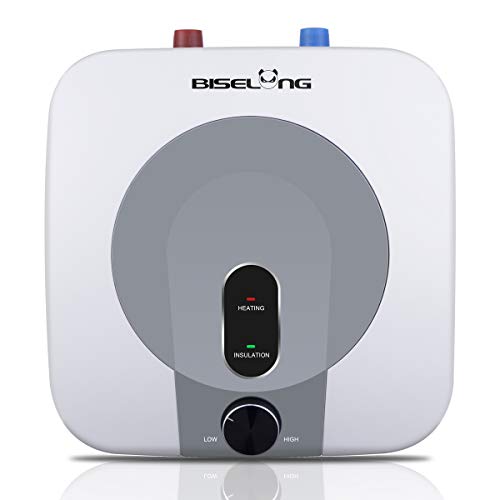
Product overview: A compact 2.5-gallon storage tank heater suitable for under-sink installation in RVs, food trucks, or small kitchens. It uses a 1500W L-shaped heating element to increase heat exchange and reduce wait times. A stainless steel body helps resist rust and leaks, with a smart control system to maintain the desired temperature and minimize scale buildup. Best for travelers who want a ready supply of hot water at two sinks without a large footprint.
Who it’s best for: RV owners needing quick hot water at a compact footprint, and small commercial setups where space is at a premium. Why selected: It combines a robust stainless build with rapid heating and temperature stability in a small enclosure. Limitation: Heating performance is optimized for smaller usage scenarios; for high flow at multiple outlets, expect modest water volume per minute.
Generic Tankless Water Heater Under Sink 3000W

Product overview: A 3000W on-demand unit designed for RV kitchens and bathrooms. It can raise water temperature rapidly and is adjustable to meet outlet temperature requirements. Note that shower use typically requires higher flow rates, so this unit is best for sinks and small basins. Best for: RVs needing fast, on-demand hot water at low to moderate flow; choose this if space is limited and you don’t need showers with strong flow. Caution: Electrical load is high—verify circuit capacity before installation.
DOYXC Tankless Water Heater 110V 3000W

Product overview: Wall-mountable, 110V tankless heater with LCD display and on-demand hot water. Features include IP44 waterproofing and safety protections, with adjustable temperature control for 0.3–0.5 GPM ranges. Best for: campers and compact kitchens needing space-saving, wall-mounted hot water on demand. Limitation: Lower maximum flow at higher temperatures; not ideal for simultaneous multiple outlets at full blast.
Feelrogast Electric Tank Water Heater, 8 Gallon

Product overview: An 8-gallon under-sink tank heater designed for RVs and small kitchens. Features a durable stainless tank, rapid heating, and multiple safety protections, including leakage and high-temperature cutoffs. Best for: those who want a larger supply of hot water for brief periods without constant reheat. Caution: Slightly larger footprint than compact 2.5-gallon models; ensure cabinet space accommodates the unit.
Orbek RV Tankless Water Heater
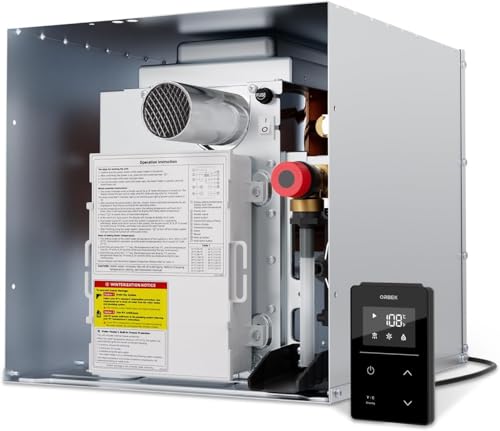
Product overview: A propane on-demand tankless system designed for RV use with remote control options. It delivers high heat output and a compact footprint, suitable for families traveling in RVs who want efficient hot water without large storage tanks. Best for: RV families needing continuous hot water and remote operation. Caution: Propane-based systems require proper ventilation and proper installation clearance in RV spaces.
Buying Guide
- Space vs. capacity: Tank models save water by storing hot water but take cabinet space; tankless units maximize efficiency and reduce bulk but have higher instantaneous electrical or gas demands. Choose based on available cabinet depth and desired continuous hot water.
- Electrical or fuel source: RV setups vary—12V or propane in many models, with some 110V electric options. Confirm the power source your RV can safely provide and consider future upgrades or camping off-grid scenarios.
- Flow rate and temperature: If you primarily run sinks, select units that deliver stable warmth at lower GPM. For showers or multiple outlets, opt for higher BTU or GPM ratings or dual-outlet designs where available.
- Protection features: Look for anti-freeze, dry-burning protection, leakage protection, and overheat safeguards to ensure safe operation in mobile environments.
- Installation footprint: Measure cabinet depth, height, and clearance to ensure proper fit. Some units are wall-mounted, others require dedicated under-sink spaces.
- Maintenance and durability: Stainless steel tanks resist rust and corrosion; consider units with reinforced seals and reliable thermal insulation to minimize heat loss.
FAQ
- What size RV water heater should I choose?
Choose based on available space and typical usage: smaller 2.5–8 gallon tanks for sinks and light use; tankless units for continuous hot water without storage. - Do I need 12V or propane for RV hot water?
Tankless options commonly use propane or electric; some compact electric versions run on 110V. Check your RV’s power setup and fuel availability. - Can these heaters supply hot water to multiple fixtures at once?
Tank units have limited simultaneous output; tankless models with higher BTU/GPM are better for multiple outlets. - Are these heaters safe in travel environments?
Yes, with appropriate protections (leakage, dry-burning, and overheat safeguards) and proper installation clearances. - What maintenance is required?
Regular inspections for leaks, gasket integrity, and ensuring proper venting for fuel-based units; flushing tankless units per manufacturer guidance helps maintain performance. - How do I determine the right flow rate?
Consider the number of outlets you’ll use simultaneously and the desired temperature rise; lower flow rates yield higher temperatures on most models.