Answer: For travel trailers off the grid, a complete solar kit or portable panel set provides reliable 12V charging, daily power, and easy monitoring. This guide highlights five practical options suited to different camping styles—from full off‑grid rigs to lightweight trips. Best for full‑time RVs with higher energy needs: ECO‑WORTHY 12V 400W Complete Solar Panel Kit. Best for compact setups and portability: Renogy 200W Portable. Best for budget-conscious or limited space: SOLPERK 20W and Voltset 20W. Best for larger energy capacity with monitoring: ECO‑WORTHY 800W Off Grid System.
| Product | Best For | |
|---|---|---|
| [Ultra] ECO-Worthy 12V 400W Complete Solar Panel Kit for RV Off Grid Travel Trailer | Full off‑grid RV kits | 400W panels + 3.5kWh storage |
| ECO-WORTHY 800W 12V 3.5KWH Off Grid Solar System | High energy needs, 24/7 monitoring | 800W panels + 3.5kWh storage |
| Renogy 200W Portable Solar Panel | Compact, space‑limited setups | 200W foldable |
| DOKIO 300W Portable Foldable Solar Panel Kit | High power, still portable | 300W foldable |
| SOLPERK Solar Panel Kit 20W | Trickle charging & maintenance | 20W |
Notes: Each option is described with who it’s best for, why it’s selected, and any practical limitation. All products are compatible with common 12V RV and trailer systems, and include or support essential components like charge controllers and mounting considerations. The buying guide at the end helps compare features, installation needs, and long‑term maintenance considerations.
[Ultra] ECO-Worthy 12V 400W Complete Solar Panel Kit
![[Ultra] ECO-Worthy 12V 400W Complete Solar Panel Kit](https://m.media-amazon.com/images/I/51TtoLjWyvL._SL500_.jpg)
This 400W complete system includes four 100W panels, a 12.8V 280Ah lithium battery, a 2000W inverter, a 40A MPPT charge controller, a monitor module, and all necessary cables. It can generate about 1600Wh daily and store up to 3.5kWh, making it suitable for RV travelers who want a ready‑to‑install off‑grid solution. Best for: RV owners seeking a turnkey, novice‑friendly setup that covers charging, storage, and power conversion in one package. Limitation: installation is larger and heavier than smaller kits, requiring more space and mounting planning.
ECO-WORTHY 800W 12V 3.5KWH Off Grid Solar System

This enhanced off‑grid kit pairs four 195W panels with a 12.8V 280Ah lithium battery, a 60A MPPT controller, a 2000W pure sine inverter, and a monitoring hub. It’s designed to power RV appliances around the clock with monitoring visibility via the hub. Best for: travelers needing substantial daytime generation and robust monitoring for long trips or higher appliance loads. Limitation: higher upfront size and weight, requiring solid mounting space and electrical planning.
Renogy 200W Portable Solar Panel

Renogy’s 200W foldable panel offers industry‑leading efficiency at about 25% with N‑Type cells. Weighing roughly 13.9 lbs and folding to compact dimensions, it’s ideal for limited space in campers, SUVs, or small trailers. Best for: space‑constrained setups that still demand solid daytime charging. Limitation: does not include a built‑in battery or inverter; needs a compatible controller or power station.
DOKIO 300W Portable Solar Panel Kit

This 300W foldable kit emphasizes portability and strong power delivery. It weighs about 15.2 lbs and folds to a compact size for easy transport and storage. It includes a standalone controller for safe charging and a long 9.85ft cable to place the panel in direct sun while keeping the controller shaded. Best for: RV owners who want a high‑power option that’s still easy to move and set up. Limitation: portable kits may require separate mounting and wiring for full integration with a trailer’s electrical system.
SOLPERK Solar Panel Kit 20W
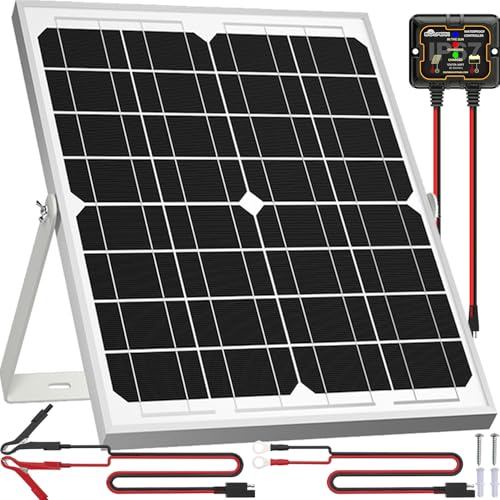
This 20W kit uses high‑efficiency A+ monocrystalline cells and includes a smart MPPT controller. It’s designed for trickle charging and maintaining 12V batteries in trailers, boats, or small campers. Best for: maintaining a battery in smaller setups or as a supplementary charging source. Limitation: limited daily power output, not suitable as the primary power source for appliances with higher energy demands.
Buying Guide: Key Purchase Considerations
- Energy needs: Assess daily watt‑hour requirements. Full RV systems deliver higher daily output, while small kits are best for maintenance and emergency backup.
- Space and weight: Portable panels save space but may require separate controllers or power stations. Larger kits need mounting space and vehicle power routing.
- Battery compatibility: Ensure your trailer battery type (LiFePO4, AGM, Gel, etc.) is supported by the controller and system.
- Charge controller type: MPPT controllers maximize efficiency in varying sunlight; PWM controllers are simpler and adequate for smaller kits.
- Monitoring and control: Systems with a monitoring hub or app provide real‑time status, helping manage night/day usage and battery health.
- Weather resilience: Look for corrosion‑resistant frames and IP ratings for outdoor use in diverse climates.
- Installation complexity: Complete kits simplify setup; modular panels work well for upgrades or phased installations.
- Longevity and warranty considerations: Consider components’ durability, service life, and replacement parts availability.
FAQ
- What size solar kit do I need for a travel trailer?
Start with daily energy needs; if you run basic appliances, a 200–400W panel set with a suitable battery can cover most days. For higher loads, consider 600–1000W systems with larger storage. - Is an MPPT controller better than PWM?
Yes. MPPT controllers convert more solar energy into usable power, especially in variable light, improving efficiency compared to PWM. - Can I install solar panels on any trailer?
Most trailers can accommodate solar panels with proper mounting, wiring, and weatherproofing. Check roof load, clearance, and mounting brackets. - Do I need a monitoring hub?
A monitoring hub helps track panel output, battery voltage, and inverter status, which can simplify maintenance and optimization. - Are portable panels as effective as roof panels?
Portable panels offer flexibility and easier storage but require manual setup and position adjustment; roof panels typically provide consistent exposure and integrated wiring. - Can these systems power high‑watt appliances?
Larger kits with high‑hour storage and inverters can run most RV appliances, but load management and peak power limits must be planned.