Answering the needs of RV travelers, this guide highlights five solar systems that are well-suited for motorhomes. Each option targets different use cases—from compact RV setups to larger off‑grid rigs—so you can choose based on energy needs, space, and installation complexity. The selections emphasize portability, reliability, and ease of use for American travelers who want dependable DC-AC power while on the road.
Below is a quick reference table of the chosen products, focusing on what each is best for and a quick suitability note.
- ECO-WORTHY 7.168KWH 800W Solar Panel Kit for RV Off Grid — Best for compact RVs needing a robust, plug‑and‑play system
- [Ultra] ECO-WORTHY 1200W 24V 5.52KWH Lithium Battery Solar System — Best for mid‑size RVs with bigger energy needs
- ECO-WORTHY 10KW Off Grid Complete Kit — Best for high‑power RVs or as a home backup on wheels
- Renogy 200W RV Solar Panel Kit — Best for space‑constrained RVs with reliable MPPT charge control
- Renogy 400W Premium 12V Kit — Best for larger RVs needing a substantial daily output
ECO-WORTHY 7.168KWH 800W RV Solar Kit

This 800W off‑grid kit is designed for RVs and campers seeking a balance of power and install ease. It includes four 200W panels, a 3000W UPS inverter charger, dual‑voltage storage, and Bluetooth MPPT management. Best for mid‑sized RVs that need steady daytime generation with reliable battery support. Choose this if you value a straightforward setup with UPS capabilities for quick power transfer during cloudy days.
Best for: Mid‑sized RVs needing dependable solar generation plus UPS backup. Caution: The system’s daily output depends on four hours of sun; actual performance varies with weather.
[Ultra] ECO-WORTHY 1200W 24V 5.52KWH System

This off‑grid system expands capacity with six 195W panels and a 12.8V 280Ah lithium configuration, offering about 5.52KWH daily output under ideal sun. It features a 60A MPPT controller and a 3000W inverter, making it suitable for larger RVs or households on wheels. Best for RVs with higher energy needs, such as running air conditioners or multiple appliances.
Best for: Larger RVs or frequent long trips where higher daily power matters. Caution: Tracking and dual‑axis features boost output but add complexity to installation.
ECO-WORTHY 10KW Off Grid Complete Kit

This large off‑grid system includes 12 panels (195W each) delivering up to 2.34kW of solar input, a 10kW inverter, and 2 lithium batteries for substantial energy storage. It is best for high‑power motorhomes or as a mobile energy hub that can support multiple heavy appliances. It is the pick when maximum daytime generation and strong backup storage are priorities.
Best for: High‑energy RVs or full‑time RVers needing substantial daily power. Caution: The setup is more complex and heavier, requiring careful installation and secure mounting.
Renogy 200W RV Solar Panel Kit
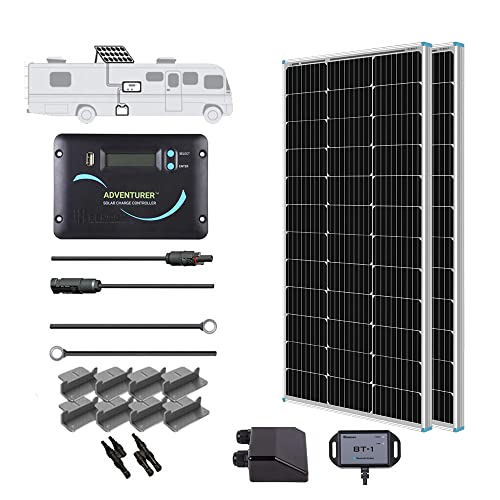
This compact kit is ideal for RVs needing a modest, reliable solar option. It includes monocrystalline panels, an Adventurer 30A PWM controller, and mounting hardware for easy installation on RV roofs. Best for smaller RVs or travelers who want a simple, affordable entry into solar power.
Limitations: PWM controllers may be less efficient in some setups compared with MPPT options.
Best for: Small to mid‑size RVs seeking a straightforward, budget‑friendly solution. Caution: PWM controllers can underperform on variable sun compared with MPPT controllers.
Renogy 400W Premium 4‑Panel Kit

This premium kit pairs four 100W panels with a 40A MPPT controller, Bluetooth module, and all necessary cabling and mounting hardware. It provides higher daily output and efficient energy management. Best for larger RVs or those needing sustained power for several devices. Advantages include efficient MPPT tracking and scalable setup.
Caution: Higher upfront cost and more components to install.
Buying Guide: Key Considerations For Motorhomes
- Power needs: Estimate daily watt‑hour consumption for common RV appliances (fridge, AC, lights, water heater, microwave). Match system daily output to your worst‑case sunny day scenario.
- System size vs. space: Roof space and weight limit your panel count. Balance high output with roof load and aerodynamics.
- Battery type and capacity: Lithium options offer deeper cycles and better endurance than lead‑acid. Consider usable capacity and charging speed for RV usage patterns.
- Inverter and controller: MPPT inverters maximize energy harvest; PWM is simpler but sometimes less efficient. Ensure the controller matches battery voltage and system amperage.
- Portability and installation: modular kits are easier to install for temporary or frequent relocations. Fixed installations suit long‑term RV life better.
- Weather and climate: In snowy or cloudy regions, more storage and robust mounting help maintain power reliability.
FAQ
- Can a motorhome run entirely on solar power?—Yes, with a properly sized kit and sufficient battery storage, depending on energy use and sun exposure.
- What size RV solar kit do I need?—It depends on daily consumption, climate, and whether you rely on AC or one major appliance. Start with a desired daily kWh target and size panels/batteries accordingly.
- Is lithium storage better than lead‑acid for RVs?—Lithium offers deeper cycles, lighter weight, and faster charging, which benefits mobile use, though at a higher upfront cost.
- Do I need a professional to install RV solar panels?—Not always; many kits are designed for DIY installation. Complex systems with 10 kW or more may require professional mounting and wiring.
- Will solar work in cloudy weather?—Solar still generates power on cloudy days, but output is reduced. Batteries and an adequate buffer help maintain power.
- Do payload and roof structure matter?—Yes. Ensure mounting hardware supports panel weight and wind loads for safe road travel.