When shopping for a US Army extreme cold weather sleeping bag, the buyer seeks rugged warmth, durability, and field-ready design. This guide highlights five top selections that balance insulation, weight, and weather resistance. Ideal for military personnel, outdoor professionals, and extreme-weather campers, these bags are analyzed for best-use scenarios, packing efficiency, and practical trade-offs. Use the quick comparison table below to jump to each product section.
| Product | Best For | Key Feature |
|---|---|---|
| Tennier Gilette Very Warm Thick Old School Military US Army Subzero ECW Bag | Hard-winter field deployments | Subzero insulation; 84” long |
| MT Army Modular Sleeping Bags System All Season | All-season versatility | Multi-layer design with bivy cover |
| MT Army Modular Sleeping Bags System All Season ( Woodland Camo ) | Recon patrols in variable climates | Polarguard HV insulation; 86.6” x 35.4” x 28” |
| Very Warm Military US Army Subzero Extreme Cold Weather ECW Down GI Bag | Extreme cold environments | OD Green; full insulation; 84” x 30” |
| MT Modular Sleep System – 4-Piece Tactical Set | Complete modular setup | Front-zip design; vacuum compression sack |
Tennier Gilette Very Warm Thick Old School US Army Subzero ECW Sleeping Bag

This US Military Issue Extreme Cold Weather Subzero sleeping bag is designed for deep winter operations. It features full insulation, a long 84-inch length, and a wide top that tapers to 14 inches at the bottom. Best for small- to medium-frame personnel when the goal is maximum warmth with reliable field durability. The primary caveat is its weight, as the bag weighs about 8 pounds, which may affect carry load on long patrols.
MT Army All-Season Modular Sleeping Bags System With Bivy Cover

MT’s all-season modular system combines a bivy cover with a multi-layer sleeping bag design. It uses a high-quality outer shell, weather-resistant seams, and Polarguard HV insulation for warmth even when damp. Best for patrol or reconnaissance tasks in fluctuating temperatures. It supports a wide size range and claims comfort in roughly 5–15°C with negatives attainable when paired with other components. A limitation is the complexity of setup and the need for all elements to perform optimally together.
MT Army All-Season Modular Sleeping Bag (Woodland Camouflage)

This MT system emphasizes a woodland camouflage option with a similar bivy cover and nylon ripstop construction. It employs high-fluff insulation and a heavy-duty YKK zipper for reliability in tough environments. Best for field operators needing robust insulation across a broader temperature range; caution: similar to other modular kits, performance relies on proper assembly and fit of all components.
Very Warm Military US Army Subzero Extreme Cold Weather ECW Down GI Bag

This version mirrors the classic subzero design with full insulation, OD green color, and the same 84-inch length. It is best for individuals who require a proven, straightforward cold-weather bag without additional layers. A potential drawback is endurance of outer fabric under abrasive field conditions, which may necessitate careful handling and storage.
MT Modular Sleep System – 4-Piece Tactical Set
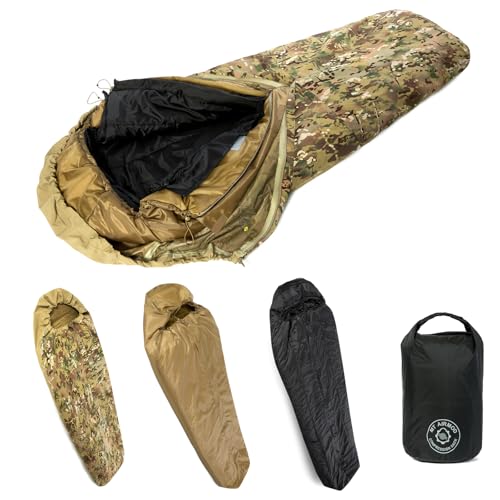
The MT 4-piece system includes Patrol and Intermediate Cold Weather bags, a bivy cover, and a vacuum compression sack. It features a front-zip design for faster entry and a water-resistant, space-saving vacuum sack. Best for users who value modularity and quick access in tactical scenarios. Limitations include the need to carry multiple components and the reliance on a compatible bivy and sack setup for optimal compression and protection.
Buying Guide
What to consider when choosing an extreme cold weather sleeping bag system:
- Insulation type and temperature rating: Prioritize high-loft insulation (down or synthetic) and a clear temperature comfort range that matches your climate and activity level.
- System completeness: Decide between a single bag or a complete modular system with bivy cover and compression gear. A bivy can improve moisture resistance and wind protection.
- Weight and packability: Heavier bags may offer more warmth but reduce mobility. Vacuum compression sacks dramatically reduce space but require care to avoid moisture buildup.
- Durability and fabric: Look for tear-resistant ripstop fabrics, robust zippers, and sealed seams for field reliability.
- Temperature stability: Some systems claim wide ranges; verify how insulation performs when damp or compressed, and consider layering for adaptable warmth.
- Care and maintenance: Military-style bags often require proper cleaning and drying to preserve insulation and loft.
Frequently Asked Questions
- What makes an ECW sleeping bag different from a standard sleeping bag?
– ECW designs emphasize higher warmth-to-weight ratios, rugged shells, and features like bivy covers and moisture management for extreme cold environments. - Is a modular sleep system better than a single bag?
– For variable climates and field use, a modular system offers flexibility. For fixed conditions, a single bag may be lighter and simpler. - What should I look for in a bivy cover?
– Look for waterproof or water-resistant properties, breathability, and compatibility with the sleep system size. - How important is weight when choosing an ECW bag?
– Weight matters for mobility during patrols and transport; higher warmth often comes with increased weight. - Can these bags be used in non-military outdoor settings?
– Yes, they are suitable for outdoor expeditions, camping, and survival scenarios where extreme cold protection is needed. - Do all these bags require a compression sack?
– Not necessarily; some systems include compression sacks or vacuum sacks to save space, while others may be bulkier.