Answering the need for safe, portable drinking water while traveling, these bottles purify on the move. They’re ideal for frequent travelers, hikers, campers, and anyone who fills from uncertain sources. The top picks below remove bacteria, parasites, microplastics, and odors, while improving taste. Each entry includes who it’s best for and why it was selected.
| Product | Best For | Why It Stands Out |
|---|---|---|
| LifeStraw Go Series 22 oz (Aegean Sea) | Frequent travelers and road-trippers | Effective microfiltration with carbon taste improvement |
| GRAYL GeoPress 24 oz (Black Camo) | Global travelers and outdoor adventures | All-in-one purification and cleaning for contaminants and VOCs |
| SurviMate 5-Stage 0.01 μm | Backcountry users and emergency kits | Small pore size with multiple filtration stages |
| GRAYL GeoPress 24 oz (Oasis Green) | Travelers with sensitive tastes or odors | Comprehensive purification plus adsorbs chemicals |
| LifeStraw Go Series Insulated 1L (Aegean Sea) | All-season travelers and daily use | Stainless steel build and strong filtration |
LifeStraw Go Series Water Filter Bottle – 22 oz (Aegean Sea)

The LifeStraw Go Series provides a BPA-free bottle with a membrane microfilter and carbon filter. It reduces bacteria, parasites, microplastics, and improves taste by lowering chlorine and odors. Best for travelers who want a compact solution for airport bathrooms, taps abroad, or road-trip stops. Limitations include cartridge replacement needs and ongoing filter maintenance in rugged trips. The bottle suits daily travelers and occasional campers who value lightweight filtration.
GRAYL GeoPress 24 oz Water Purifier Bottle – Black Camo
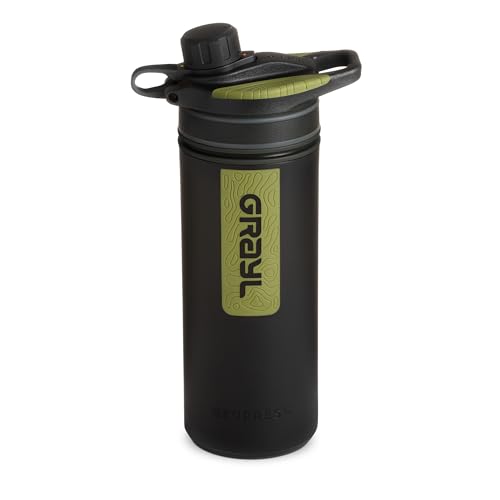
GRAYL GeoPress purifies water anywhere by filtering viruses, bacteria, and protozoa while cleaning particulates and adsorbing VOCs, PFAS, and other chemicals. It’s best for global travel, hiking, and emergency use when you need reliable purification with a simple press mechanism. A limitation is the need to press to operate, which may be less convenient during very rugged treks. Choose this for consistent performance in diverse environments and fast purification.
SurviMate 5-Stage 0.01 μm Ultra-Filtration Bottle

The SurviMate bottle uses a 5-stage filtration system with a 0.01 μm hollow fiber UF membrane and activated carbon for chlorine removal and odor reduction. It’s NSF/ANSI 42 certified and includes a built-in sediment filter. Best for hikers and campers who need higher filtration precision and a compact, portable unit. A potential drawback is the more involved maintenance schedule due to multiple stages.
GRAYL GeoPress 24 oz Water Purifier Bottle – Oasis Green

This GeoPress model purifies water anywhere, removing viruses, bacteria, and protozoa while filtering particulates and adsorbing chemicals and heavy metals. It’s best for travelers who want straightforward purification with odor and flavor improvement. The Oasis Green color simply differentiates models. A caveat is the device’s size in very tight packs.
LifeStraw Go Series Insulated 1L – Aegan Sea

The insulated LifeStraw Go Series bottle combines a stainless steel body with a BPA-free interior and the same high-grade filtration as the 22 oz version. It’s best for travelers who experience temperature swings or prefer a durable steel bottle. It maintains filtration capability while offering better insulation. Better for all-season travel; however, it’s heavier than plastic options.
Buying Guide: Key Considerations For Travel Purification Bottles
- Filtration vs. purification: Filtration typically removes particulates and bacteria, while purification targets a broader range of pathogens and chemicals. Consider your most common travel environments.
- Pore size and certifications: A smaller pore size (like 0.01 μm) generally means higher filtration precision. Certifications like NSF/ANSI 42 indicate validated performance in odor and taste reduction and contaminant removal.
- Flow rate and usability: Bottles with easy “press” or sip mechanisms are preferable for on-the-go use, but require consistent maintenance to prevent clogs.
- Build and weight: Plastic BPA-free bottles are lighter but less durable; stainless steel versions offer durability and insulation at the cost of weight.
- Maintenance and replacement parts: Check cartridge or filter replacement frequency, cost, and availability in your travel regions.
- Capacity and portability: 22 oz to 1 L options balance filtration efficiency with portability. Consider how often you’ll refill during a day.
- Best-use scenarios: Global travel vs. outdoor adventures may favor GrayL’s all-in-one purifier or LifeStraw’s simple, field-tested design.
FAQ
- What’s the main difference between filtration and purification bottles?
– Filtration typically removes particulates and bacteria, while purification can remove viruses and additional chemicals. Products like GrayL and SurviMate offer broad purification with multiple stages. - Are these bottles safe for all water sources?
– They are designed for common travel water sources but may not address seawater or highly contaminated industrial water. Follow manufacturer guidance for extreme cases. - How often should I replace filters or cartridges?
– Replacement frequency depends on usage and water quality. Check product documentation for recommended intervals and cost considerations. - Which bottle is best for camping?
– SurviMate’s 0.01 μm UF membrane and GRAYL’s all-in-one purifier are strong choices for backcountry trips and emergency use. - Do these bottles improve taste?
– Yes, carbon filters and adsorption of odor compounds can improve taste and odor in tap or questionable water sources. - Is there a risk of incomplete purification if water is very dirty?
– Filtration systems have limits; heavily turbid water should be pre-filtered when possible, and filtration devices should be cleaned regularly to maintain efficacy.